In this article:
- What to Expect on the Mardi Himal Trek
- Mardi Himal Trek: Route, Stages & GPS Track
- Mardi Himal Trek Trip Report
- Getting There
- Packing List & Essential Gear
- Accommodation & Budgeting for the Trek
- Guides & Permits
- How Difficult is the Mardi Himal Trek?
- Best Time to Visit the Mardi Himal Trek
- How to Combine the Mardi Himal Trek with ABC & Poon Hill
- Final Thoughts
Ten years ago, the Mardi Himal Trek was still something of an insider tip. Today it’s one of the most popular routes in Kaski District, the lush foothills of the southern Annapurnas. What changed? Simply put – the trek is just that good. Word was bound to spread. The trails are easy to follow, the scenery is incredibly varied and the mountain views are nothing short of spectacular. Few treks offer such dramatic Himalayan panoramas for so little effort.
It’s no surprise, then, that the Mardi Himal Trek has quickly become something of a classic. My own experience with it, though, is a bit more mixed. I first hiked it in 2022, during my first trip to Nepal – right after finishing the Annapurna Circuit, and, unfortunately, at a less-than-ideal time of year. By late April, visibility was already pretty poor, and I barely caught a glimpse of the famous views the trek is known for. Unsurprisingly, I came away a little underwhelmed.

Gute Outdoor-Ausrüstung. Bessere Preise.
Entdecke ausgewählte Angebote für Trekking, Wandern und Outdoor – handverlesen und persönlich von mir ausgewählt.
My Second Time on the Mardi Himal Trek
Even so, the Mardi Himal Trek never quite let go of me. In the autumn of 2025, I found myself back in Pokhara with a few spare days – and on a bit of a whim, I decided to give it another shot. Maybe this time, it would be different.
Short version: it was absolutely worth it. And then some.
This time, I finally experienced what the Mardi Himal Trek is known for: beautiful trails, ever-changing mountain landscapes and five days of jaw-dropping views of the snow-covered peaks of the Annapurna range. As a bonus, I even turned the route into a small adventure by adding a lesser-known side trail that made the whole loop feel much more unique.
TL;DR: If you’re short on time and want to dive straight into the Himalayas, the Mardi Himal Trek is one of the best options in Nepal.
So – let’s take a closer look at the trek.



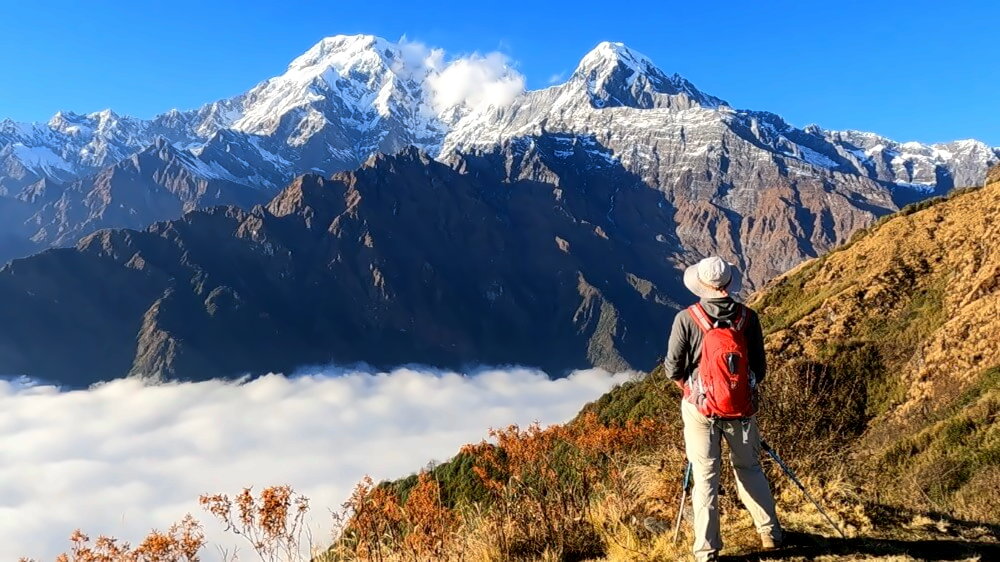
At a Glance:
- 🌄 Beginner-friendly lodge trek with some of the best panoramic views in the Annapurna region
- 🧭 Distance: approx. 50 km
- ⛰️ Elevation gain: +4,320 m / -4,810 m
- 🥾 Duration: 4–5 days
- ⚠️ Difficulty: easy to moderate
- 🔥 Adventure rating: moderate
- 🏠 Accommodation and meals available in guesthouses along the trail
- 📍 No guide required

What to Expect on the Mardi Himal Trek
Pristine mountain forests, sweeping viewpoints above lush green hills—and just two days later, a breathtaking 360° panorama of the snow-covered Annapurna range. That’s the Mardi Himal Trek in a nutshell. Few treks in Nepal pack so much variety and such dramatic Himalayan scenery into such a short amount of time.
Another big advantage is how easy it is to reach. Starting from Pokhara, there’s no long, bone-rattling bus ride like you’d have on the way to Langtang or other remote regions. The trails themselves are mostly wide, well-maintained trekking paths and nights are spent in small lodges – often in beautiful locations with fantastic mountain views.
Culturally, the trek isn’t quite as rich as some others in Nepal and it has become fairly popular in recent years. Even so, it’s still noticeably quieter than the nearby Annapurna Base Camp Trek.
A Hidden Gem?
Speaking of tourists, many trekking agencies still market the Mardi Himal Trek as a “hidden gem” or a “newly discovered route.” Take that with a pinch of salt.
The route was first explored in the early 2000s by the trekking organization TAAN and the first lodges only started appearing around 2012. Before that, it was a proper camping trek, only doable with full expedition-style gear.
Today, Mardi Himal is very much an established teahouse trek. When I first visited in 2022, construction was still ongoing in several places but that’s largely been completed now. Every few kilometers, you’ll find small lodge clusters along the trail – something that’s very much needed, as the trek has grown significantly in popularity in recent years, especially among young Nepali and Indian travelers.
Hiking Guides and Maps
My recommendation: Himalayan Travel Guides – Trekking the Annapurna Circuit
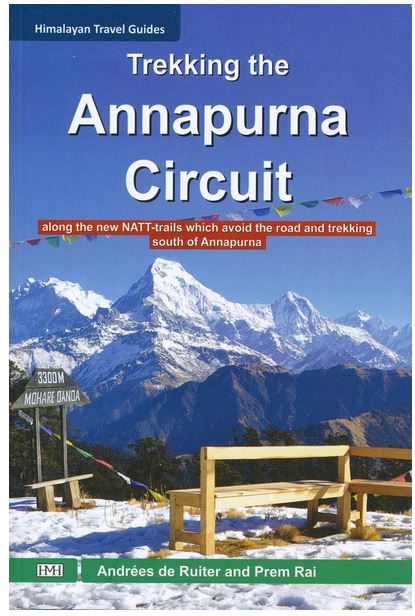
The excellent guidebook Trekking the Annapurna Circuit* is, in my opinion, the best book currently available on the Annapurna region and my top recommendation for independent trekkers.
In addition to the Mardi Himal Trek, it also covers many other routes, including the ABC Trek, the Poon Hill circuit, and the Khopra Danda Trek. One of its biggest strengths is the detailed coverage of side trails and lesser-known routes, making it perfect for putting together your own custom itineraries.
Combined with a good trekking map*, this book is essentially the key to the Annapurna region.
If you like using classic paper maps, I can recommend the Mardi Himal Trek* map by Nepa Maps (scale 1:50,000). It covers the entire area south of Mardi Himal, including villages and lodges, and the scale is perfectly adequate for trekking. Of course, you can also buy the map in Kathmandu or Pokhara. Still, it can be worth getting it in advance for planning purposes.
Route of the Mardi Himal Trek
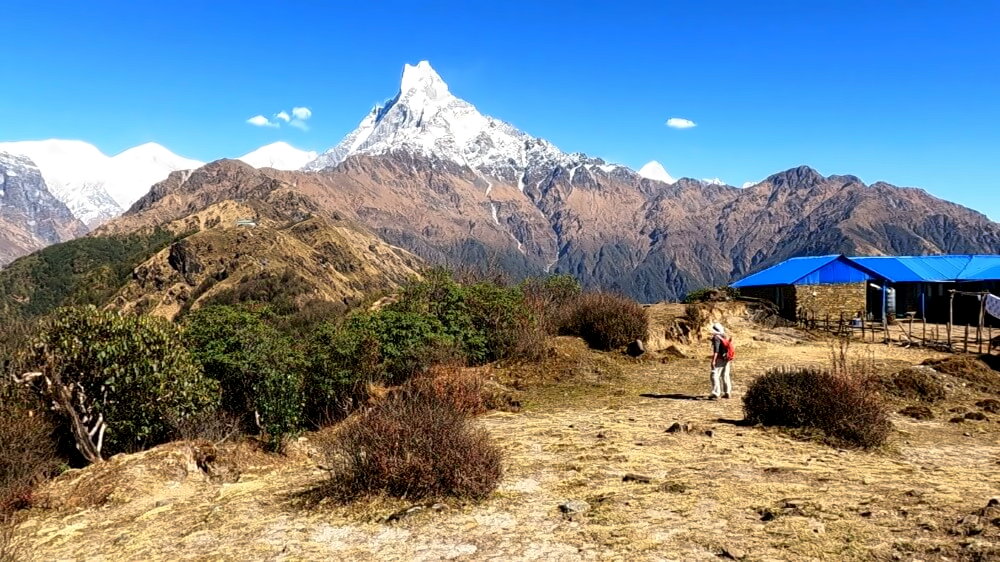
The Mardi Himal Trek begins in the gentle, rolling hills of Kaski District and gradually climbs onto a narrow ridge suspended between the Modi Khola and Mardi Khola valleys. From here, the landscape opens up dramatically, drawing you toward the southwest ridge of Mount Machapuchare (6,997 m) – the sacred “Fishtail” peak, instantly recognizable by its striking double summit and one of the most iconic silhouettes in the central Himalaya.
The trail itself doesn’t lead all the way to Machapuchare, though. Instead, it ends at Mardi Himal (5,535 m), a far less prominent peak, quietly tucked beside its famous neighbor.
Mardi Himal Trek Map:
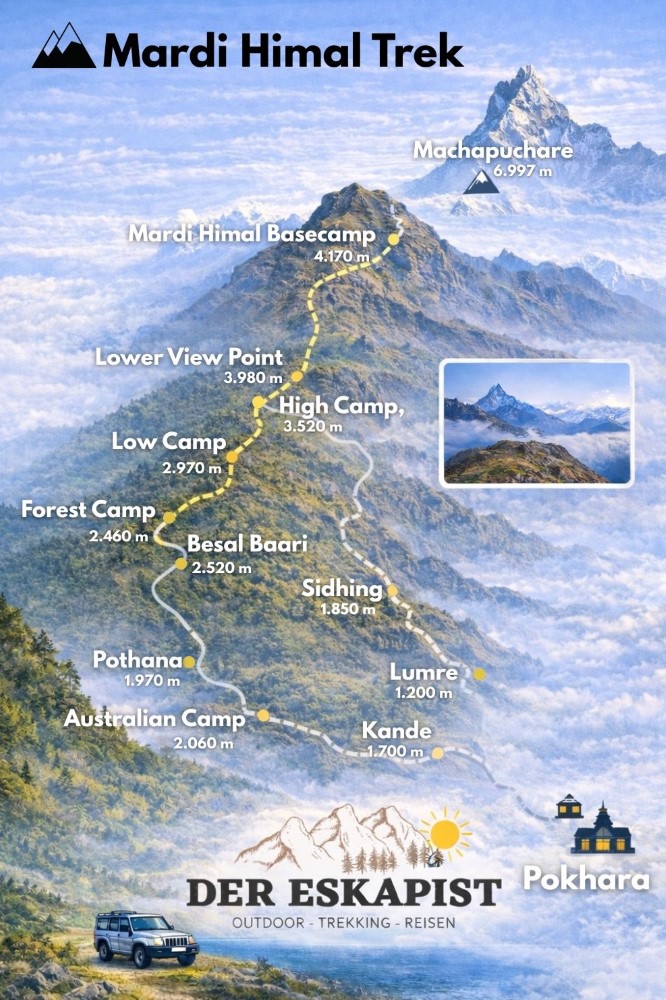
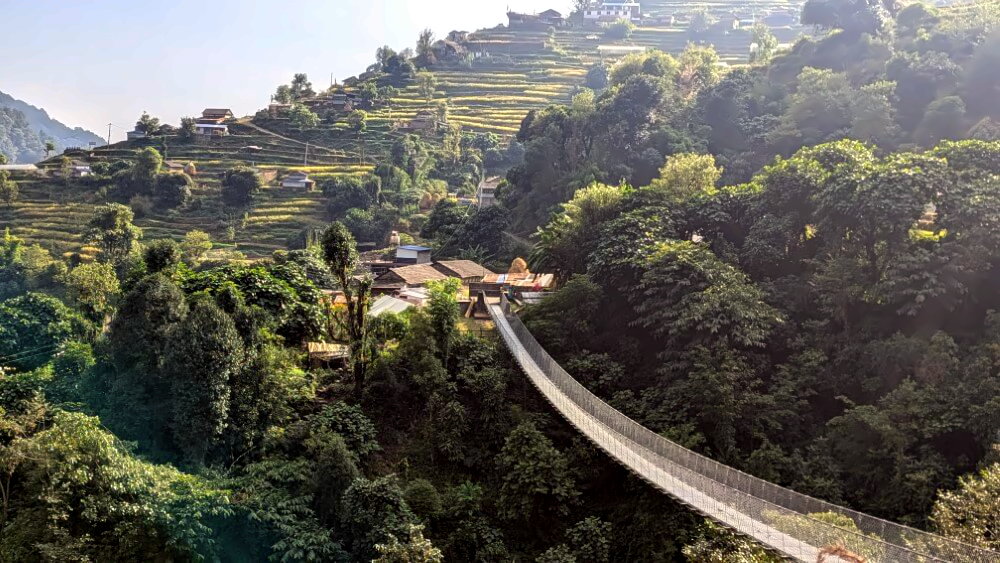
The most popular route to the Mardi Himal ridge begins in the village of Kande, around 25 kilometers from Pokhara along National Highway 3. From here, the trail winds steadily upward through the forested foothills of the Annapurna Conservation Area, passing a string of small lodge settlements along the way.
As you gain altitude, the dense forest gradually thins out, giving way to more open terrain at around 3,000 meters. The final overnight stop is Mardi Himal High Camp, perched at roughly 3,500 meters—right on the edge of the ridge, with the high Himalaya suddenly within reach.
From High Camp, a day trip to Mardi Himal Base Camp is a must – the trail to this viewpoint offers some of the best panoramas of the entire trek. Most hikers retrace their steps afterward and descend toward Sidhing. I opted for a more rewarding variation instead, following an old shepherd’s path that winds through quiet, untouched forest all the way down to the small hamlet of Lumre in the Mardi Valley. From there, it’s an easy bus ride back to Pokhara.
Download the GPS-Track for Mardi Himal Trek

Mardi Himal Trek starting from Pokhara
If you’re starting the Mardi Himal Trek from Pokhara, this is one way to break it down into a five-day itinerary. The daily stages are planned with gradual elevation gain in mind – key for proper acclimatization – which is why days two and three are intentionally shorter.
You can follow this itinerary as it is, even without prior acclimatization.
| 🥾 Stage | 🧭 Route | 📏 Length | ⛰️ Elevation gain |
|---|---|---|---|
| 01 | Kande – Besal Baari | ca. 25 km Jeep/Bus, 12 km zu Fuß | +1070, – 290 m |
| 02 | Besal Baari – Low Camp | 5,2 km | + 630, – 150 m |
| 03 | Low Camp – Mardi Himal High Camp | 4,2 km | + 555, – 20 m |
| 04 | Mardi Himal High Camp – Mardi Himal Basecamp | 11 km | + 760, – 760 m |
| 05 | Mardi Himal High Camp – Lumre | 15,5 km | + 370, – 2.740 m |
Note: On the way back, you can also retrace your steps from High Camp to Low Camp and descend to Sidhing. I’ve marked the junction in the GPS track and included a separate track for this option in the download bundle. It’s a useful alternative if the descent to Lumre isn’t safe due to bad weather, such as snow or heavy rain.
In good weather, though, I’d definitely recommend the route described here. The upper section in particular comes with fantastic views of the eastern Annapurnas, Lamjung Himal, and down into the Mardi Valley – and you won’t have to retrace your steps. Another big plus: from Lumre, there’s a direct bus back to Pokhara, whereas from Sidhing you’ll have to rely on jeeps.

Mardi Himal Trek Trip Report
Below you’ll find my personal account of the Mardi Himal Trek, based on notes and photos I took along the way. Further down, I’ve put together all the key tips you’ll need to plan your own trek.
Day 1: Kande – Besal Baari
A short taxi ride from Pokhara—about half an hour—brings me to Kande. Early in the morning, a thick layer of clouds still hangs over the lush green hills, but I know it won’t last. Over the past few weeks, I’ve learned how quickly the sky clears here.
The trail kicks off straight away with a steep climb up stone steps—classic Nepal. There’s no easing into it: every ascent is tackled head-on and that pattern will define the next few days. Luckily, I’m traveling light. My pack weighs just over five kilos, which already feels like a very good decision.
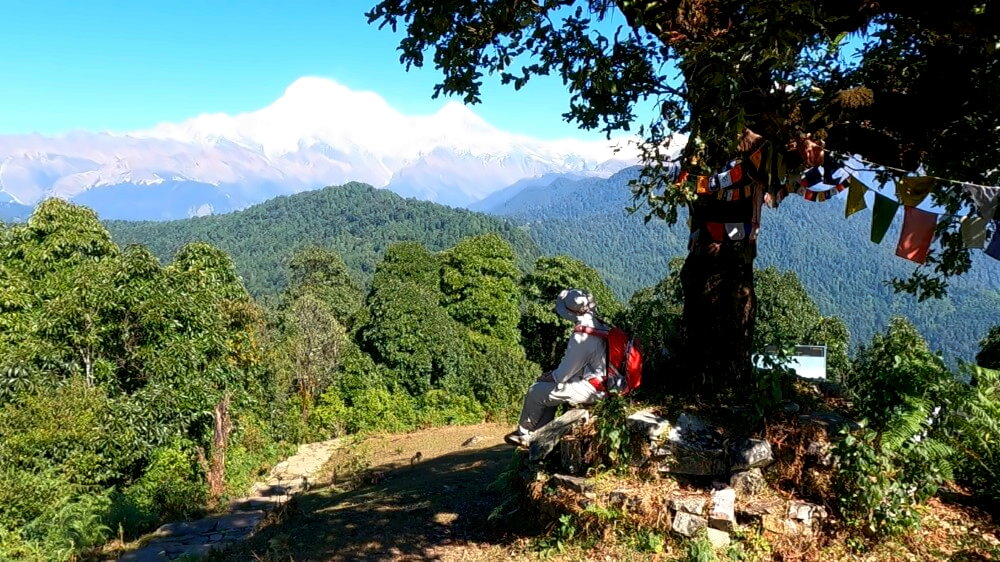
At Australian Camp, I stop for breakfast on the lawn of Hotel Gurans, soaking in the crisp morning air and the first of many sweeping mountain views. The small cluster of lodges sits right on a ridgeline and, strictly speaking, it should actually be called “Austrian Camp.”
The name goes back to the early days of trekking tourism, when Austrian hikers and mountaineers camped here – literally, in tents. Somewhere along the way, “Austrian” turned into “Australian.” To Nepali ears, the two probably sounded close enough and the name stuck.
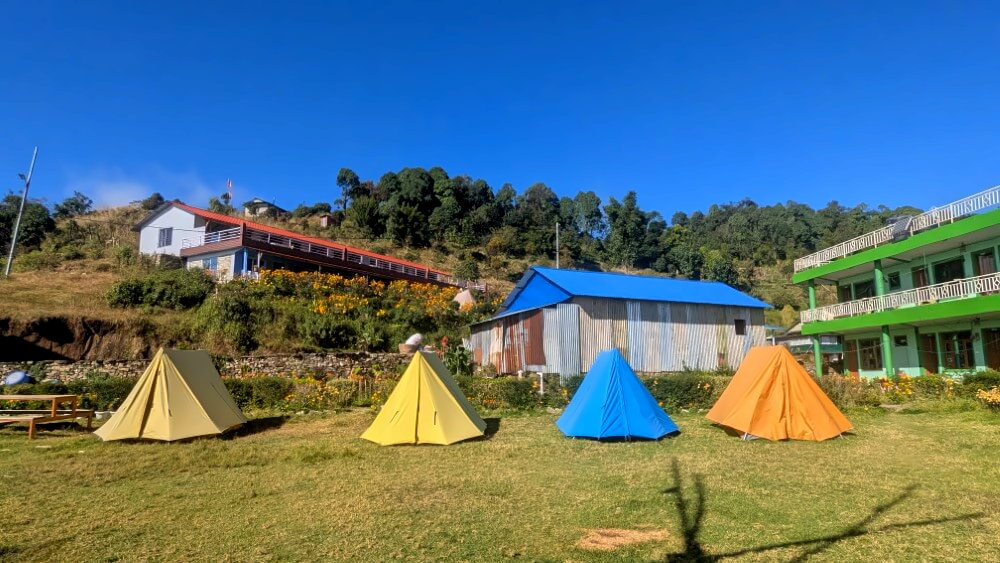
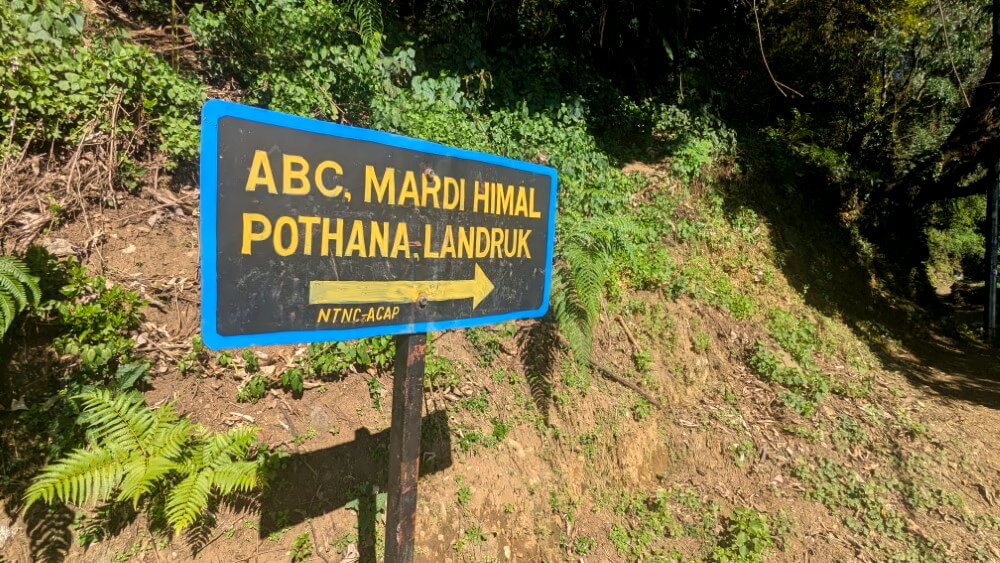

From here, the trail winds through a lush green rhododendron forest, following a well-marked stone path to Pothana – another small “village,” if you’re willing to be a bit generous with the term. In reality, it’s mostly a cluster of lodges and restaurants catering to trekkers.
The views, though – that’s something else! From the nearby viewpoint tower, I take a moment to look out over the rolling hills and deep valleys below. The clouds have lifted and under a brilliant blue sky, the Annapurna range reveals itself in full – absolutely stunning.
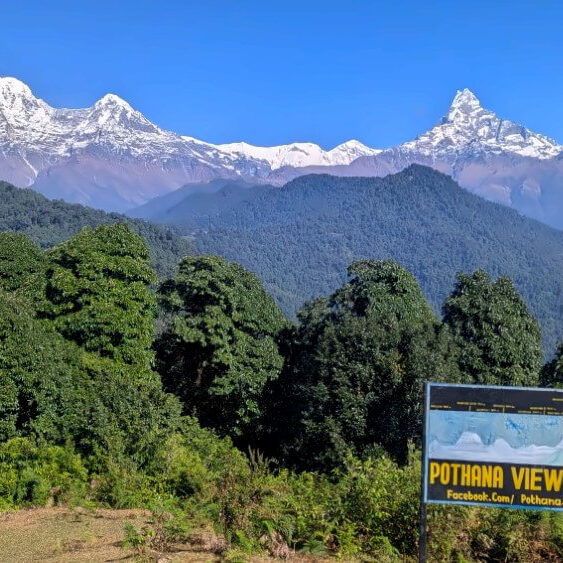

Just beyond Pothana, I pass a checkpoint where my permit is checked. The ACAP officer barely glances at my phone – quick, efficient, no paperwork. Things have changed: these days, the permit is fully digital. Further along, I pass a series of lodges, each one a little more polished than the last. It’s clear that development has reached this part of the trail, too. The last time I was here, these were simple wooden shacks – now they`ve turned into surprisingly well-built guesthouses.
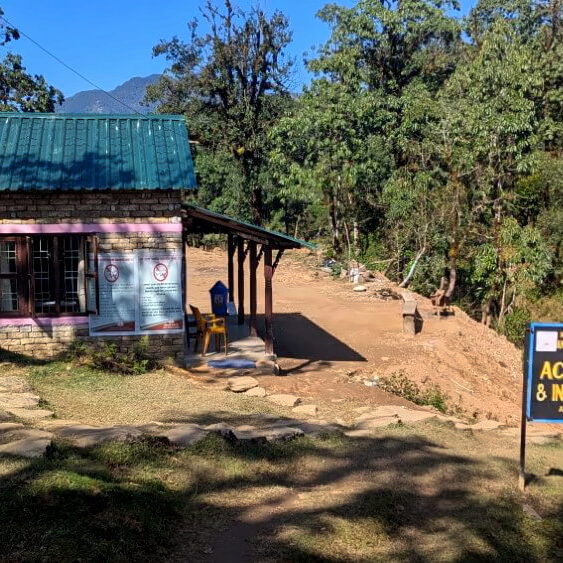
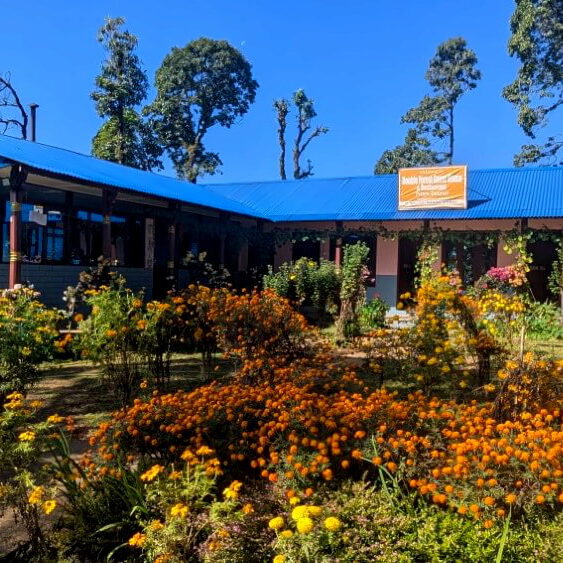
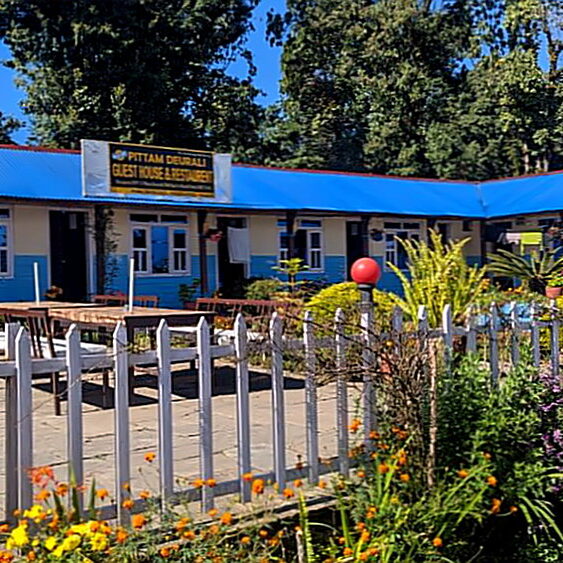
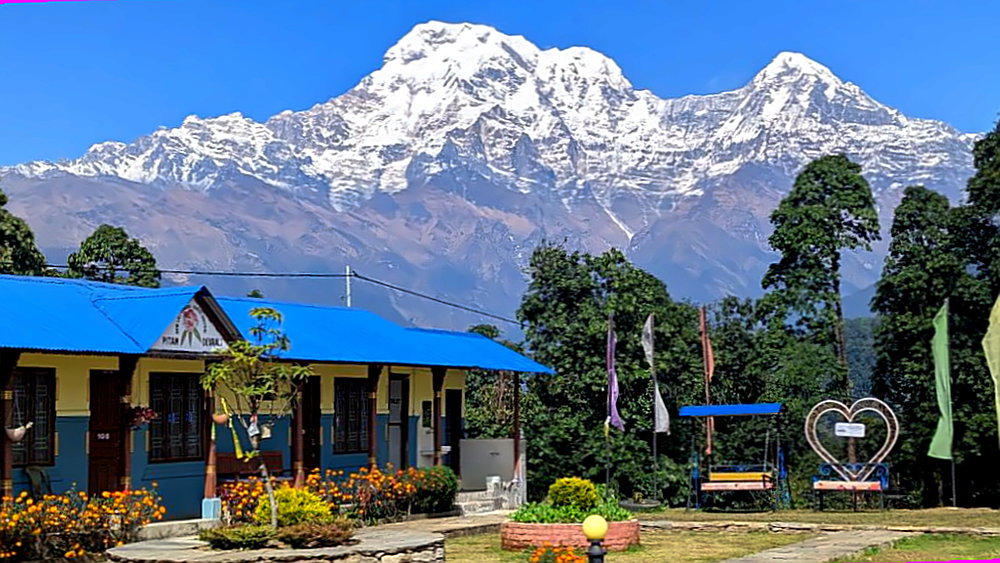
In Pitham Deurali, where a trail branches off toward Landruk in the Modi Khola valley, I stop for another tea break. With views like these, it’s impossible to just keep walking. Machapuchare, Annapurna South, Hiunchuli – they feel almost within reach, as if you could touch them. In reality, they tower nearly 5,000 meters above me, despite being less than 20 kilometers away in a straight line. It boggles the mind to think how fast these mountains rise from the surrounding hills.
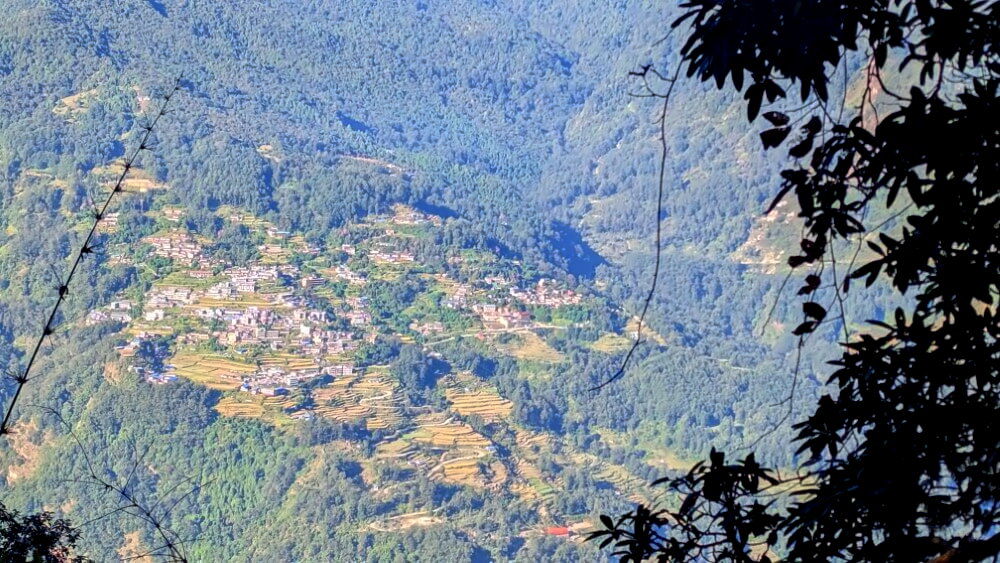
A little further on, the trail splits. I take the right fork and make a short detour to the shrine at Shree Masaikon Barah. The climb is noticeably steeper, with most of the elevation gain packed into a short stretch. At the top, a small, charming temple sits quietly in the forest. Across the valley, Ghandruk comes into view – the largest and wealthiest village in the region. Looking down from here, nearly 1,000 meters above, the houses seem like tiny toy buildings scattered across the hillside.
As I continue through the dense mountain forest, thin wisps of mist drift between the gnarled trees, giving the whole scene an almost otherworldly feel. At the next teahouse, beside the small pond of Paknikalde Pokhari, I politely decline an offer to “upgrade” my trail snacks with a portion of weed. It grows wild here in abundance and seems to be very popular—especially among local trekkers. I guess, you could call it the Nepali counterpart to the cold beer many western hikers swear by…
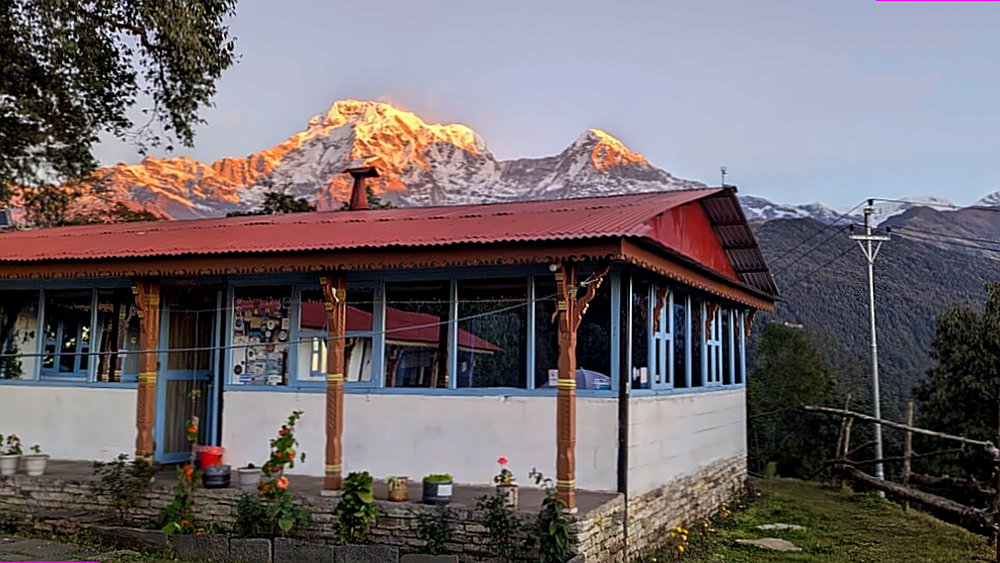
About an hour later, I reach my stop for the day: Besal Baari. There’s just a single lodge here – Hotel Demand – but the view of Machapuchare is outstanding. Most trekkers push on to Forest Camp, but I prefer staying here. Together with Akira, a lively Japanese retiree traveling solo like me, I watch the setting sun cast a warm, reddish glow over the peaks. It’s a magical moment and a perfect end to the first day.
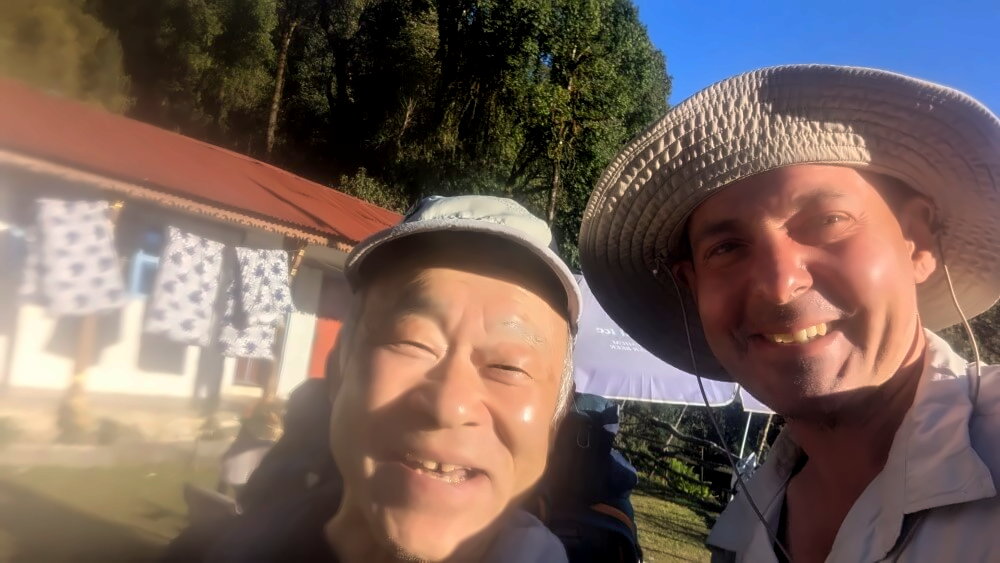
Day 2: Hotel Demand – Low Camp
Akira is already up and on the move early, while I take it a bit slower and don’t set off until around 10 a.m. – the stage ahead is short anyway. Following a narrow trail through the forest, I make my way to Forest Camp, one of the larger lodge clusters along the route. For the first time, it noticeably gets busier here. Several trails converge at this point, including one coming up from Kalimati in the Mardi Khola valley – a popular starting option for those short on time.
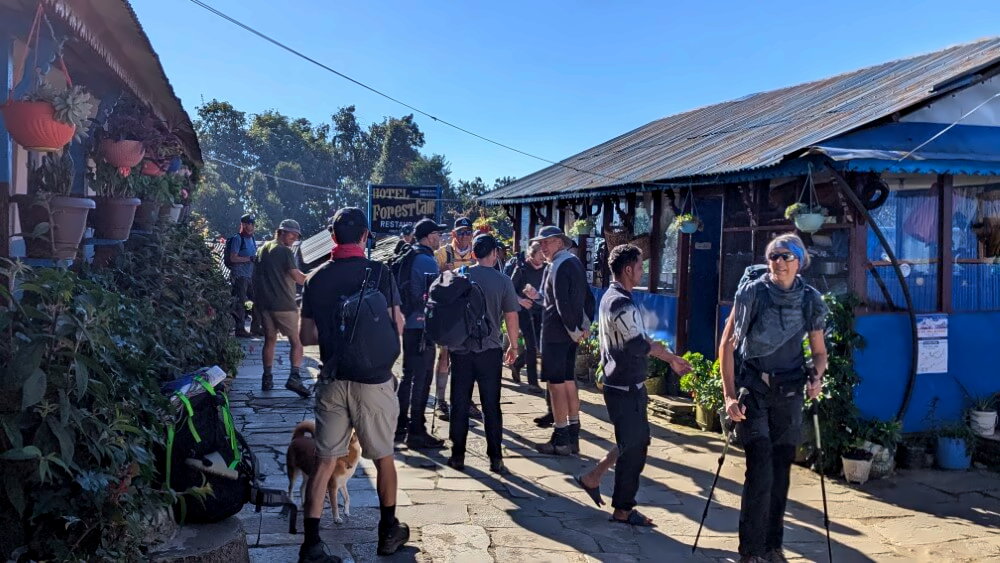
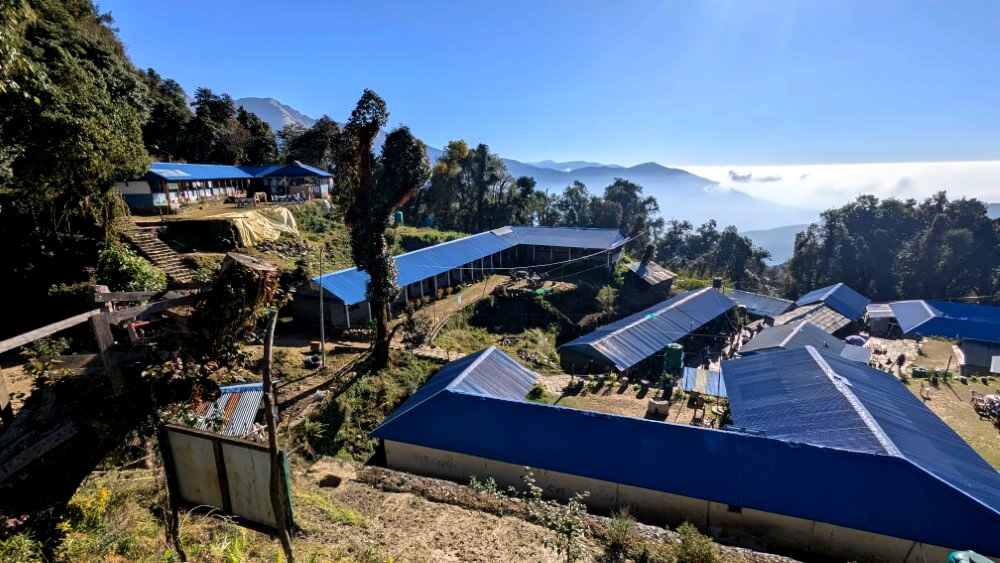
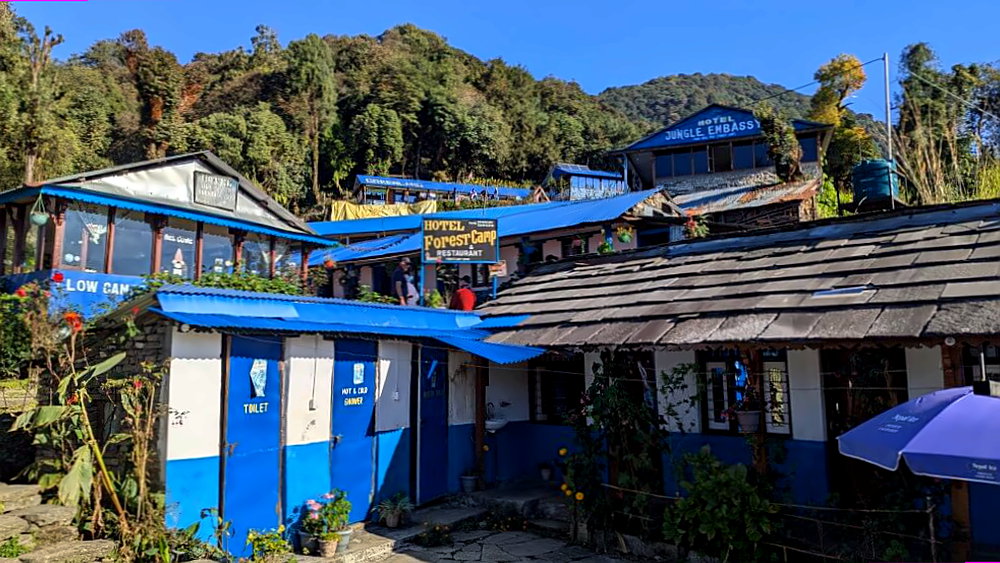
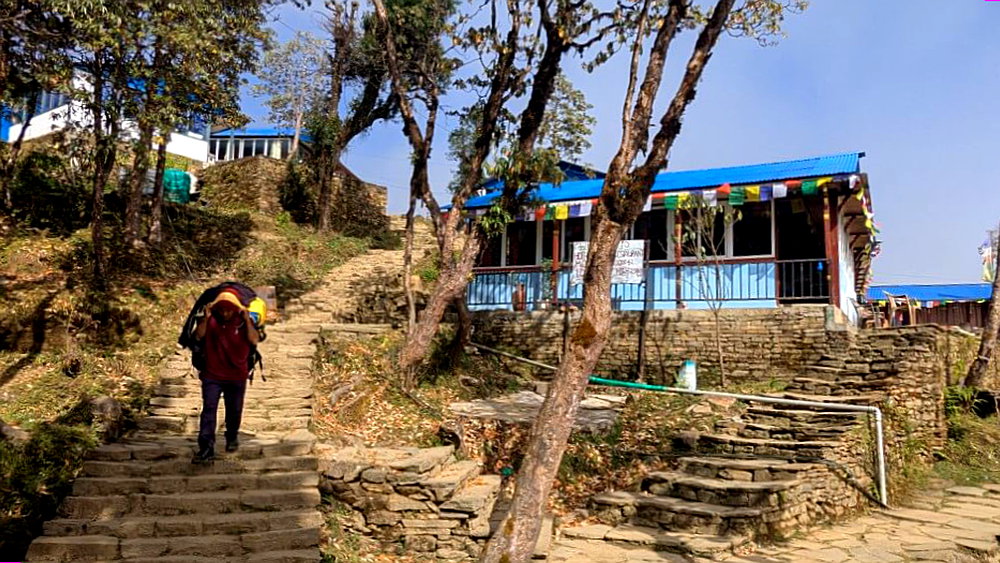
After the obligatory tea break, I move on. From here, the real climb begins—the ascent up to the ridge that will lead me to Mardi Himal High Camp tomorrow. And, as so often in Nepal, that means one thing: stairs. Endless stairs. And then some more stairs. Still, it’s beautiful walking: The trail winds its way steadily upward, threading through the ancient trunks of the rhododendron forest.

I also notice how well the trail is marked these days, with blue dots guiding the way. The first time I was here, you occasionally had to guess where the path continued. Now, everything feels much more developed – the stone staircases, in particular, look relatively new.
The same goes for the small Rest Camp along the way. Back in 2022, some of the lodges were little more than corrugated metal shacks. Now they’ve been transformed into neat, well-designed mountain lodges, complete with terraces and nice viewpoints.
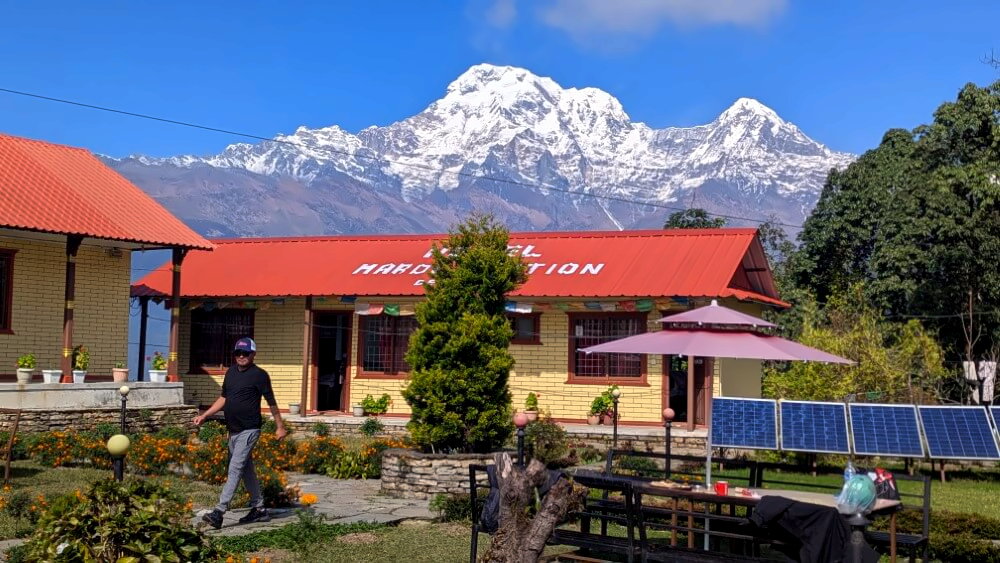
Naturally, I take every chance to pause and soak it all in. The difference to spring couldn’t be more striking. Back in April, the humidity often swallowed the whole mountain range. Now, in November, the sky is a deep, cloudless blue, the air is crisp and clear and the views seem to stretch on forever.

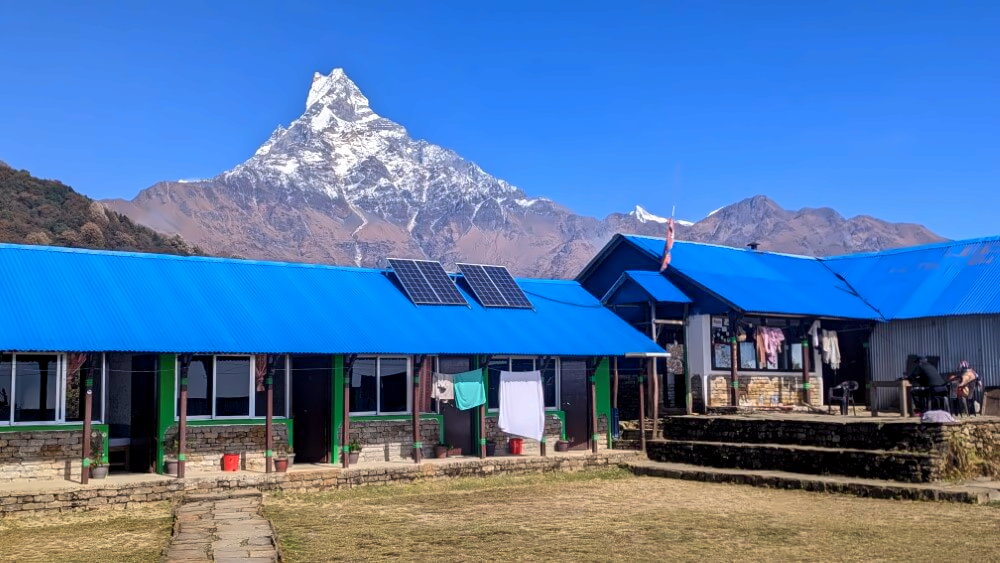
Despite taking it easy, I reach Low Camp by around 2 p.m. but that’s hardly an issue. In Nepal, time seems to move at its own pace and in autumn the afternoons slip by quickly, anyway. A cup of tea turns into another, maybe a few pages of a book, a good look at the view – and before long, it’s time for dinner. As the sun sets, the summit of Machapuchare glows in a deep red once again. Spectacular, every single time.

Tag 3: Low Camp – Mardi Himal High Camp
Day three is even shorter, so I take it slow again in the morning. The plan—unsurprisingly—is another climb. That’s pretty much the rhythm of trekking in Nepal: you’re either going up or going down. In the first half, it’s almost always up. The second half tends to be one long descent, often covering the same distance as several previous stages in a single day. But I’m not there just yet.

As expected, there are plenty of lodge stops along the way again. Today’s route passes Mid Camp, Badal Danda, and Lower High Camp, just below the actual Mardi High Camp. I can’t help but smile – Nepalis have really made the most of every available patch of land here. If there were any space left, you’d probably find an “Upper Mid Camp” or a “Middle High Camp” popping up in a few years.
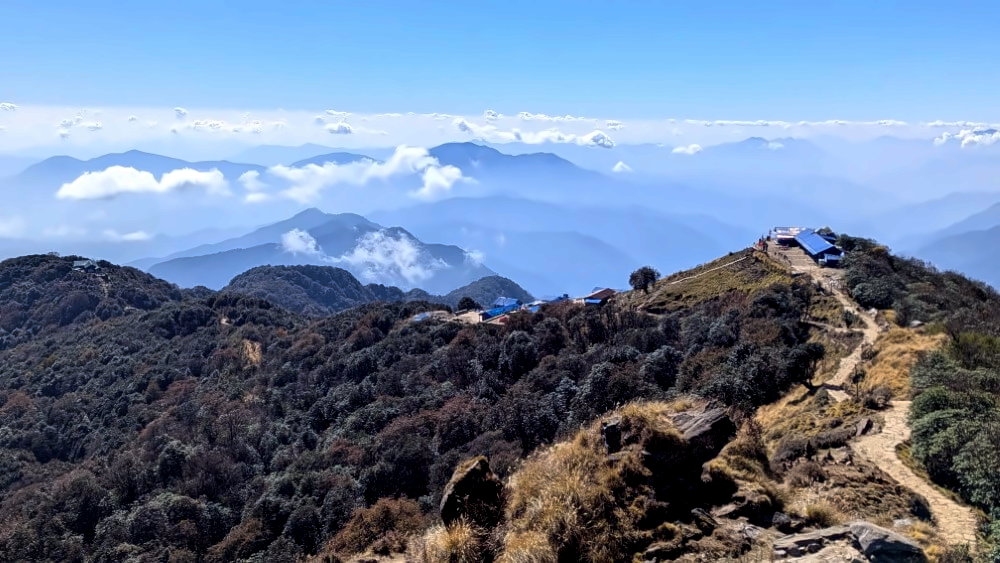
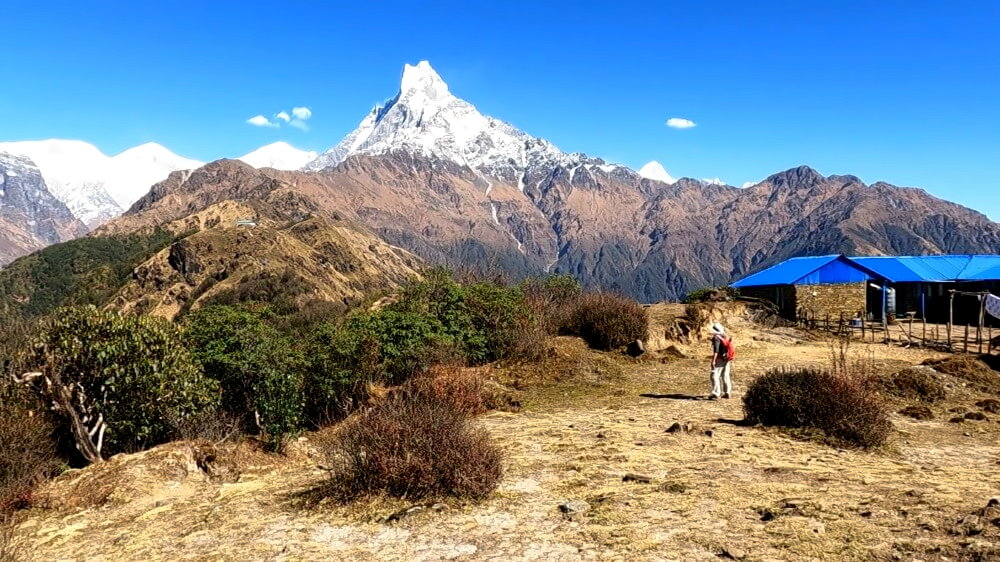
At around 3,000 meters, I reach tree line and the rhododendron forest slowly begins to thin out. Just beyond Mid Camp, about halfway along the route, the landscape suddenly opens up – and now the views become truly spectacular.
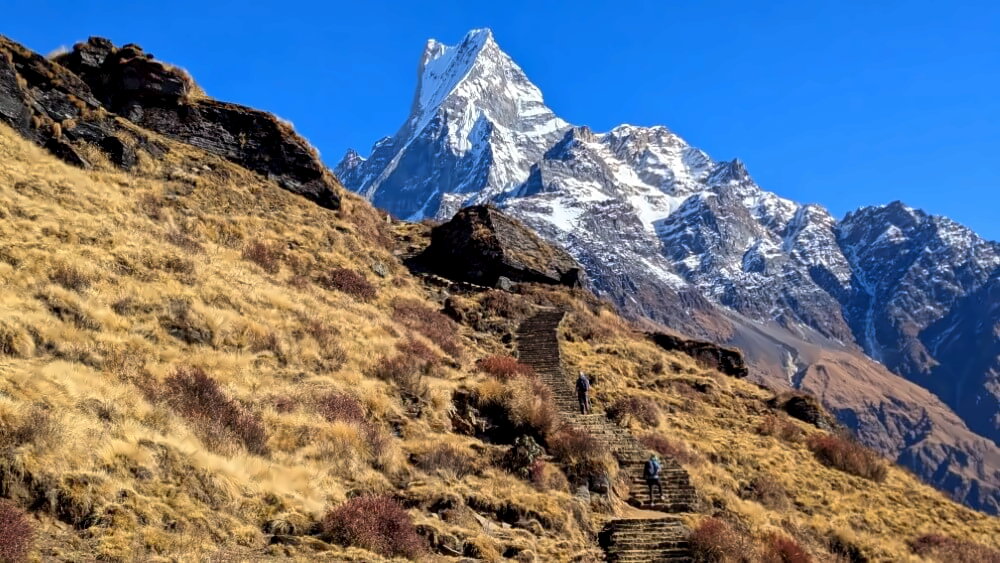
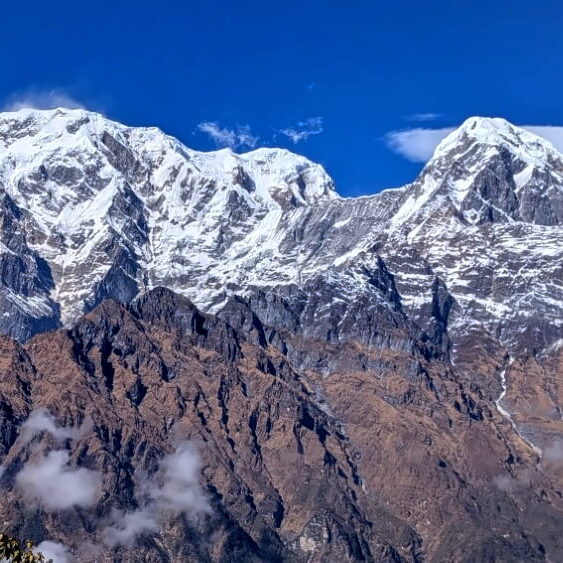
For the first time, the full ridge stretches out ahead of me. To the right, Annapurna South rises steeply into the sky, a massive wall of ice, while to the north, the unmistakable silhouette of Machapuchare dominates the horizon. Incredibly, the air is so clear that I can make out the slender snow flutings on the narrow crest connecting the twin summits.

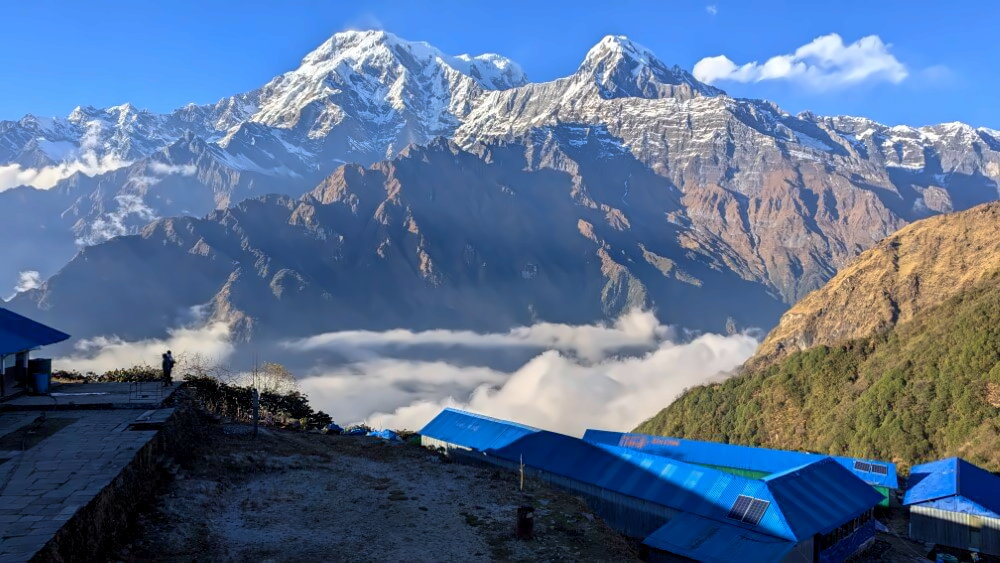
Just before reaching High Camp at 3,500 meters, there’s one final push—a steep staircase that seems to go on forever, the lodges above always just out of reach. And then, suddenly, I’m there. End of the day. Mardi Himal High Camp marks the final cluster of lodges on the trek – and even this place has grown a little since my last visit.



By now, High Camp probably has around twenty lodges, yet finding a bed turns out to be surprisingly difficult. The place is absolutely packed. I spend nearly an hour going from door to door before someone at Hotel Magic Mountain finally offers me a spot, sharing a room with a Dutch trekker.
In the afternoon, everyone gathers in the common room—drinking tea, chatting, and waiting for the evening to settle in. But once the sun disappears, it quickly turns cold. Heating with firewood isn’t allowed in the Annapurna Conservation Area, after too many of the region’s rhododendron forests were cut down in the past. And if no alternative fuel is available, the stove simply stays cold.
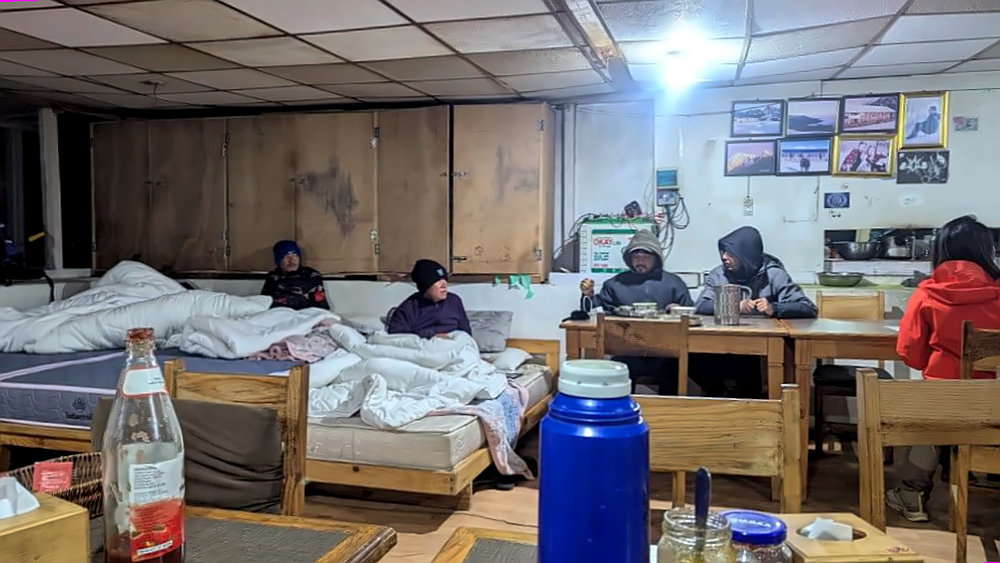
As a result, many of the guides spend most of their time tucked away in bed—it’s the warmest place around. Late in the evening, a Chinese trekker bursts into the room, grinning from ear to ear. “I made it—Mardi Himal Base Camp!” The whole room breaks into applause, with high fives all around. Not long after, I head off to bed as well.
Tag 4: Mardi Himal High Camp – Mardi Himal Basecamp
2:30 a.m. I’m still lying in bed, but outside it already sounds like a full-on departure rush. Many trekkers set off in the middle of the night to reach the ridge viewpoint – like the hiking group from India currently getting ready to leave.
The reason, as so often, is time pressure. They plan to hike all the way back down to the valley the same day and continue on to Pokhara. If that’s your style… I roll over and go back to sleep. My plan is a little more relaxed: start around 10 a.m., take my time, and return to High Camp in the evening for another night.

After the usual breakfast – chocolate pancakes and coffee – I set off. Not far beyond High Camp, the trail steepens, climbing steadily toward the first viewpoint. It’s about 400 meters of elevation gain, but the path is well built – stone-paved and even fitted with railings in places. Very user-friendly, almost surprisingly so at this altitude.
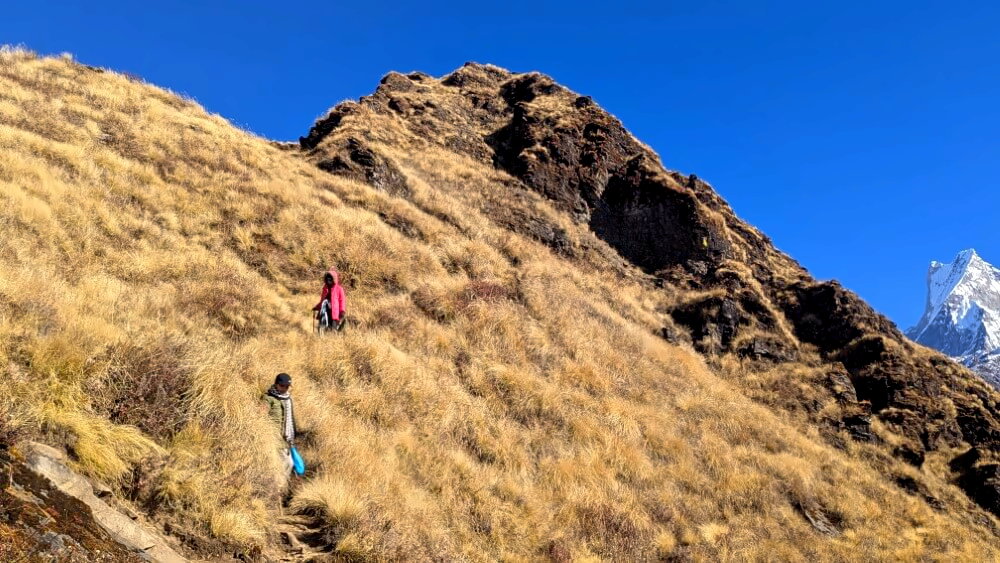
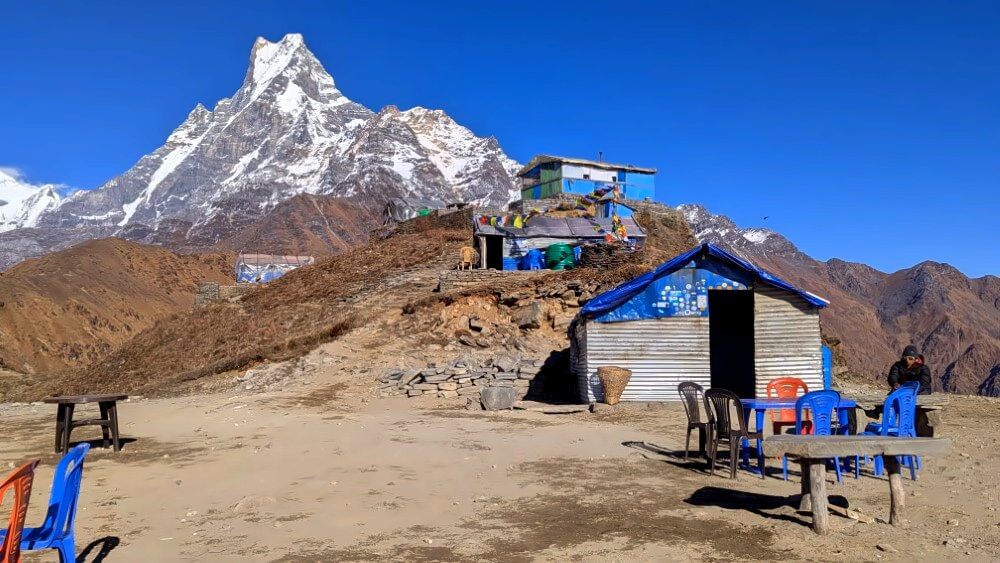
By around 11 a.m., quite a few people are already on their way back down from the Lower Viewpoint. Most hikers turn around here, grab a cup of tea, take in the view, and call it a day. That’s exactly what I did last time. But this time, with the weather on my side, I decide to keep going – pushing all the way to the last accessible point along the ridge, as far as you can get without any technical climbing.

Beyond the viewpoint, the trail narrows, turns rockier, and feels a bit more rugged. Now this is what a proper mountain path looks like. At one point, I even have to scramble for a few meters along a narrow goat track across a slightly exposed section of the ridge. Nothing too serious – just enough to keep things interesting.
And, as always, it’s worth it – the views are outstanding.
Even after seven months in the Himalayas, moments like this still take me by surprise. What fascinates me most are the colors. In autumn, the grass along the ridge turns a deep orange-brown, creating a striking contrast with the snow-white summit of Machapuchare rising directly ahead.
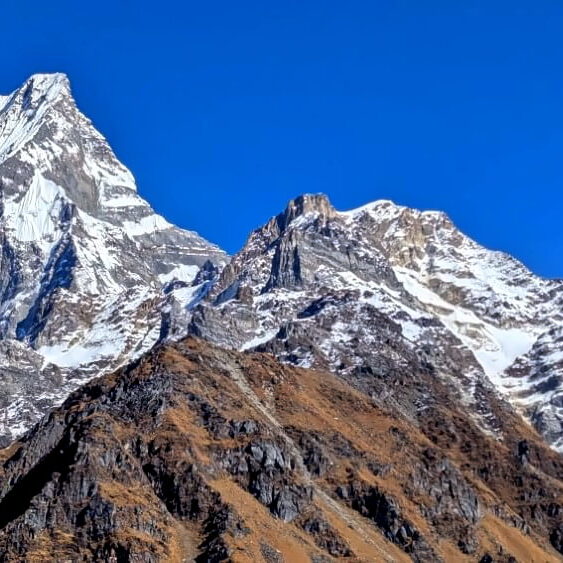
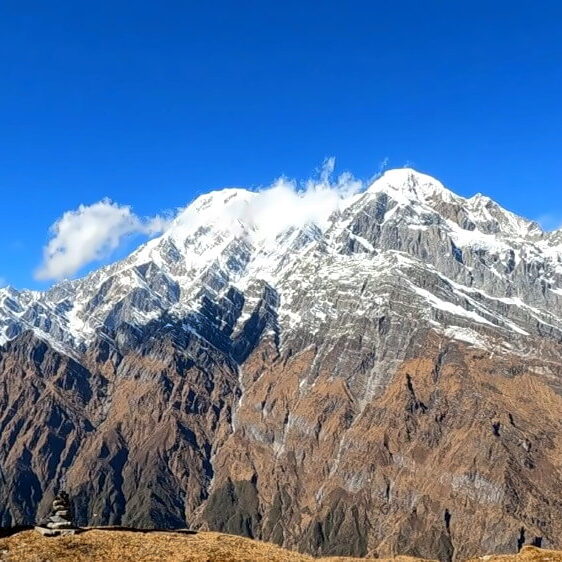
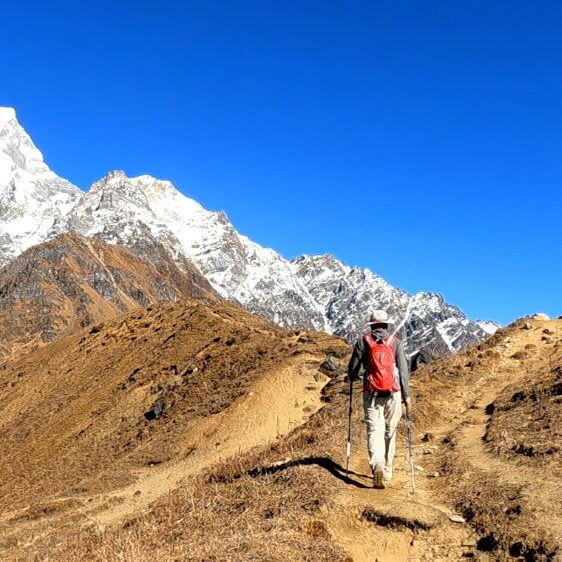
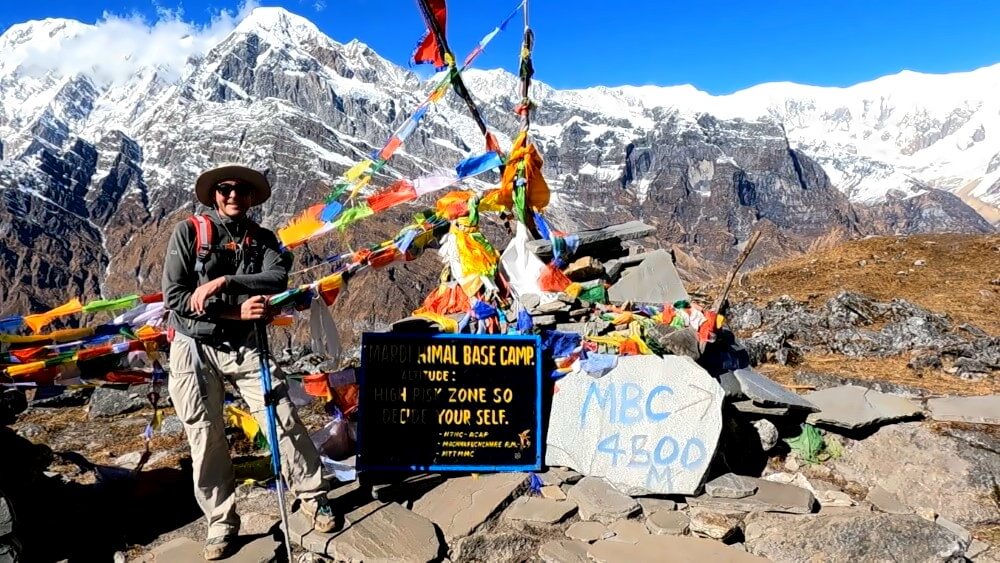
On the maps, several viewpoints are marked along the ridge. The last of them -the so-called “Upper Viewpoint” at around 4,120 meters – is also known locally as Mardi Himal Base Camp, marked by a cluster of colorful prayer flags. Naturally, I stop for the obligatory photo.
But for me, the hike isn’t over yet. Up to this point, I’ve still crossed paths with a few other trekkers – but beyond here, the trail quickly empties out, and I find myself completely alone.
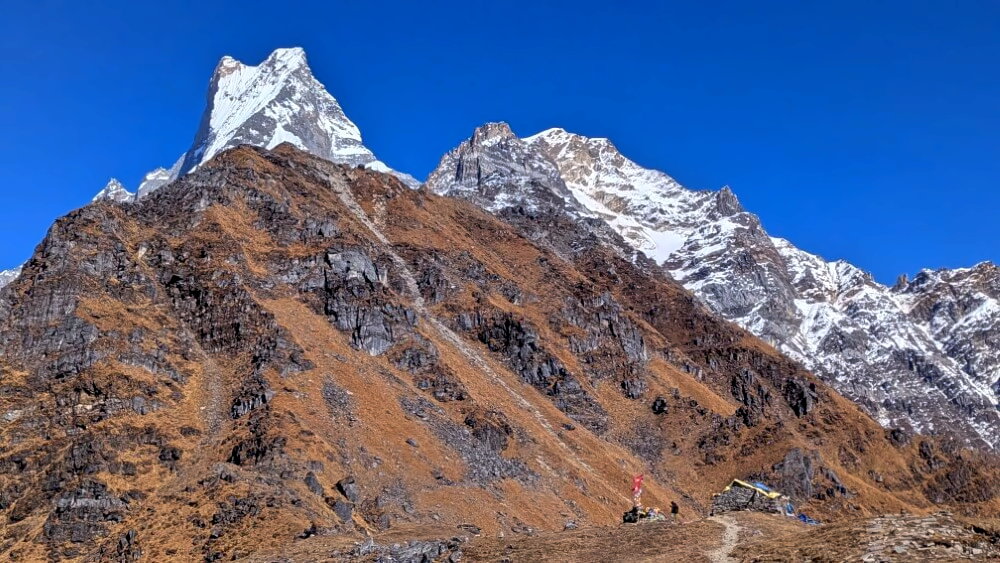
I pass a few small stone shelters as the trail contours along the southern flank of a rugged, rocky hill. Somewhere up there lies the actual Mardi Himal Base Camp—the true end point for mountaineers. Beyond that, there’s nothing but rock, snow, and ice. For hikers, this is as far as it goes.
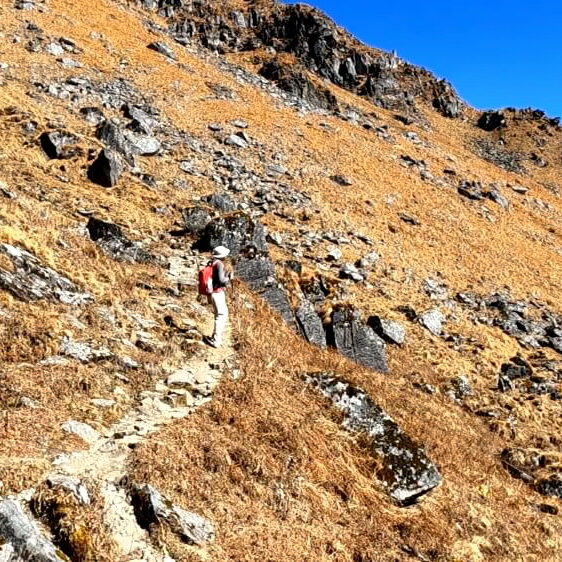
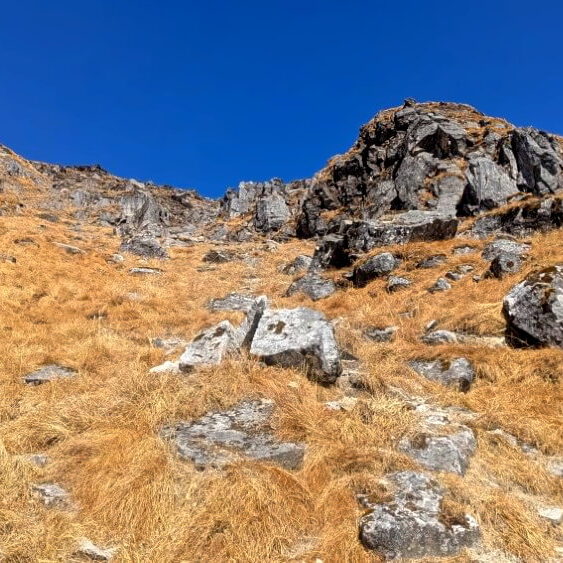
Even here, the trail starts to feel a bit more demanding. I follow the increasingly faint footpath up to a small pass just below 4,300 meters. Beyond that, it simply fades away into ankle-high grass. The slopes are fairly steep, and it doesn’t feel entirely comfortable. Better to turn around – one more viewpoint isn’t going to make much of a difference anyway.
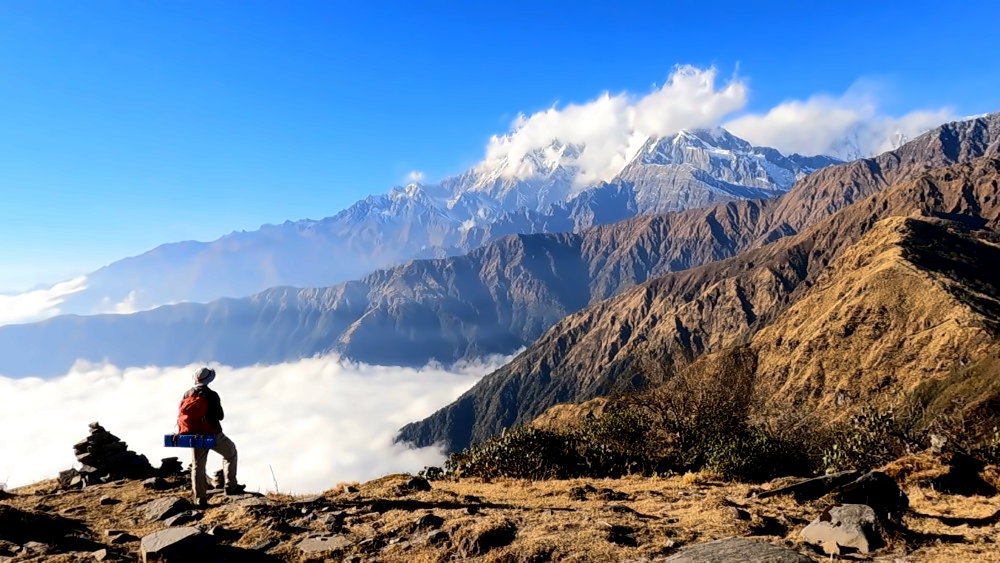
On the way back along the ridge, an incredible scene unfolds. The valleys below are blanketed in a dense layer of clouds, with only a few hills and the high peaks rising like islands from a sea of white. Up here, the sun is shining, it’s pleasantly warm – and by now, there’s hardly anyone else around.
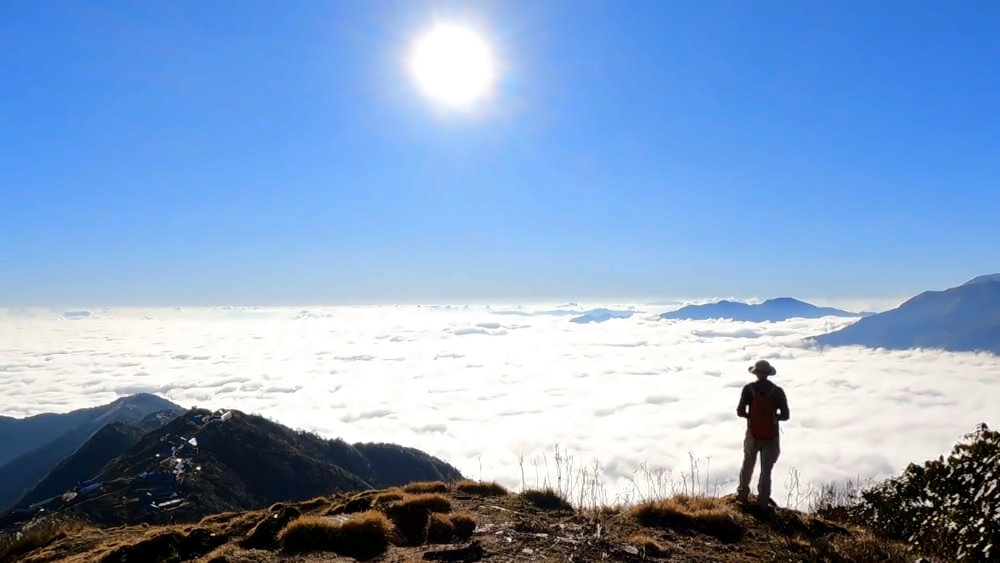
That’s the real advantage of taking your time and allowing for a day trip like this. Moments like these simply don’t happen if you rush through a trek, ticking off viewpoints one after another. I make my way back to the lodge in high spirits.
The owner, unsurprisingly, is back in bed. I get the feeling he rarely leaves it.
Day 5: Mardi Himal High Camp – Lumre
And just like that, the Mardi Himal Trek is almost over. The past four days have been incredible – and I decide to finish it on a slightly more adventurous note.
Most trekkers head back the same way, descending from High Camp to Low Camp and then on to Sidhing. But there’s another option: a direct route from High Camp down into the valley. It’s the more interesting choice and it means I won’t have to retrace the same stretch I’ve already hiked on the way up.
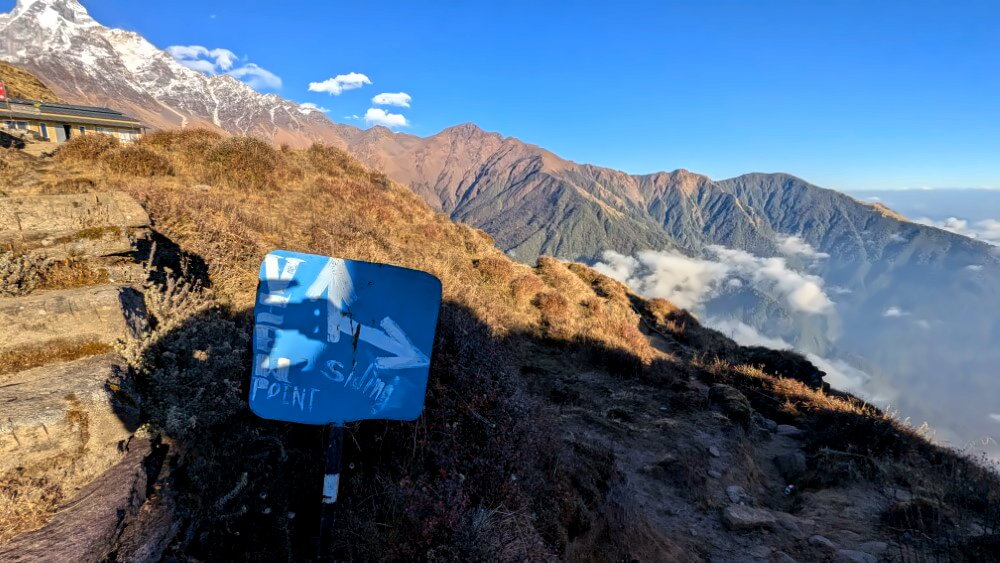
Before the trek, I could hardly find any reliable information about this route—just an old warning online calling it dangerous and risky. When I bring it up with the owner of Magic Mountain—who, as usual, is lying in bed behind the counter—he simply waves it off. No problem.
“No tourists, but Nepali people walk it all the time.”
He does suggest I pack some lunch, though. There are no lodges along the way, and aside from a few goat herders, I’ll likely have the trail to myself.
Sounds exactly like my kind of route.

I set off a little after 9 a.m. – a bit later than planned. It’s a long way down and the descent will make it feel even longer. The last bus from Lumre leaves at 4 p.m., so I really need to make it. There’s not much room for delays – but it should work out.
The start is straightforward enough. A short distance beyond camp, a path branches off to the right, following a water pipeline. Apart from the fact that it’s not stone-paved, it feels like any other mountain trail.

The trail winds gently down the slopes, and to my right, Machapuchare and Lamjung Himal come into view once more – what a panorama, a perfect finale to the trek.
As I descend across the open grassy hillsides, I pass a series of simple wooden frameworks: makeshift shelters used by shepherds. During the monsoon, when the grass is lush and green, Gurung herders bring their livestock up into the mountains and spend the summer here. Their shelters are as simple as it gets: wooden frames covered with a plastic tarp as protection from the rain.
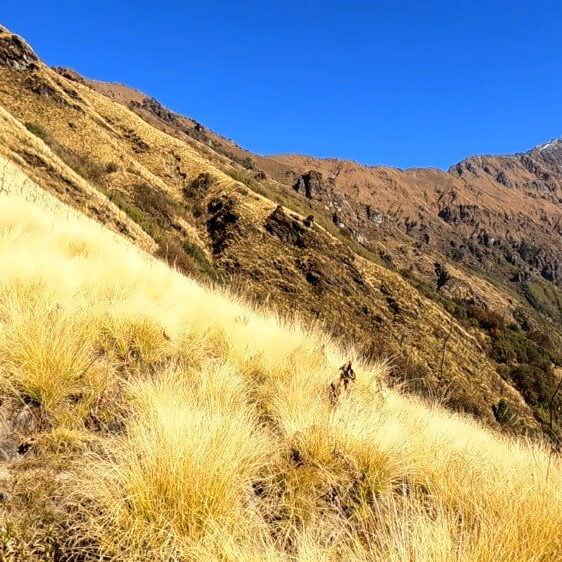

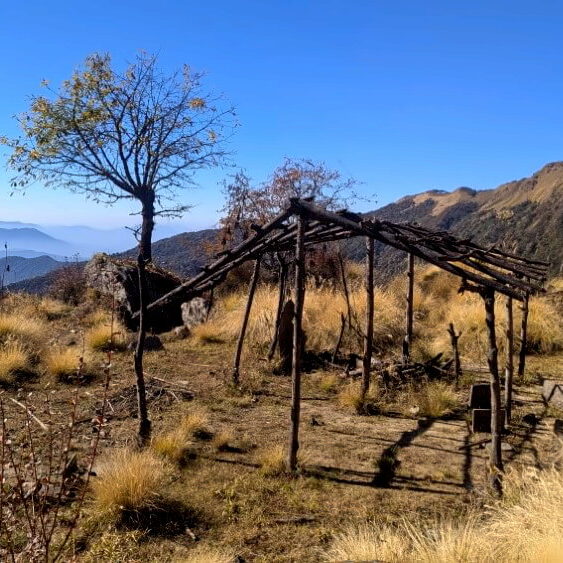
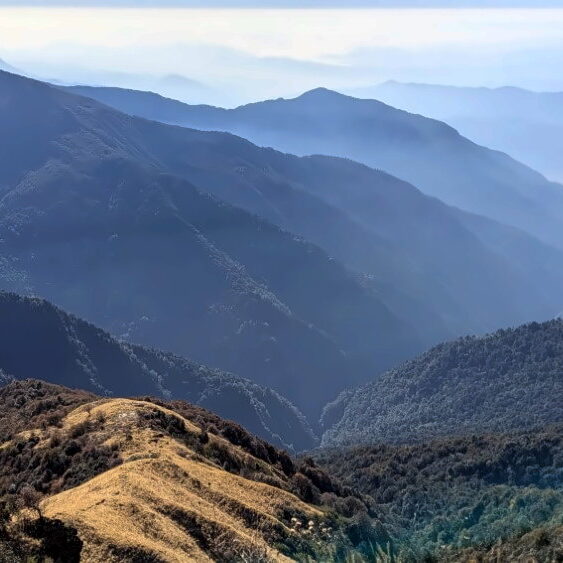
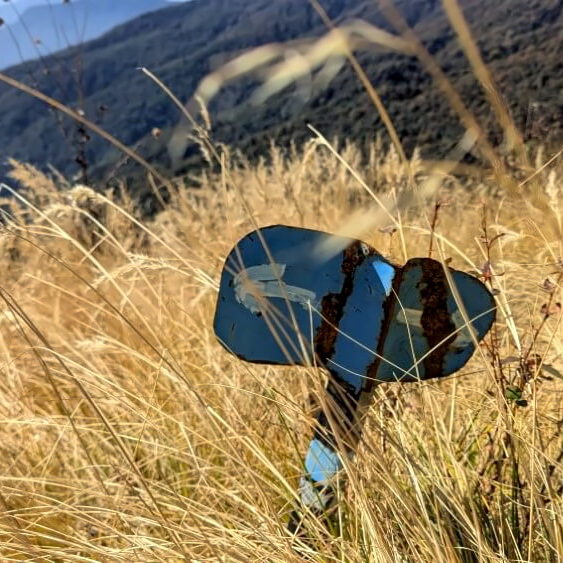
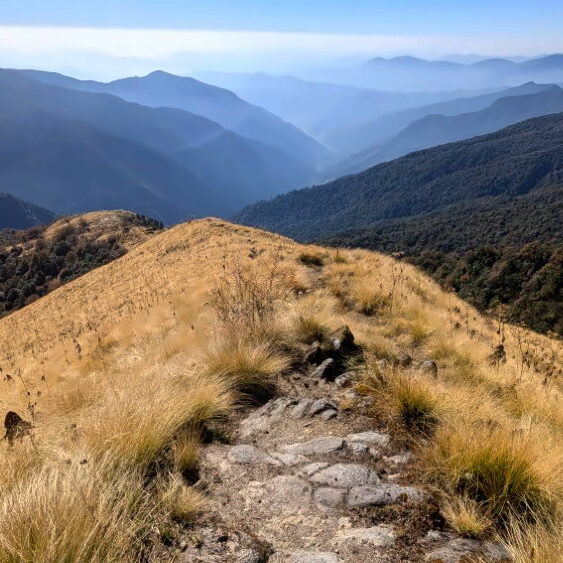
Further down, I drop below the tree line again, the trail now blanketed in dry leaves. Hardly anyone seems to come this way – at least that’s my impression and I like it very much.
The forest also feels different here: denser, wilder, alive with birds, with something rustling in the undergrowth at every turn. And yet, navigation remains surprisingly easy. The path is well marked, with blue dots on the trees sometimes no more than ten meters apart and I make good progress.
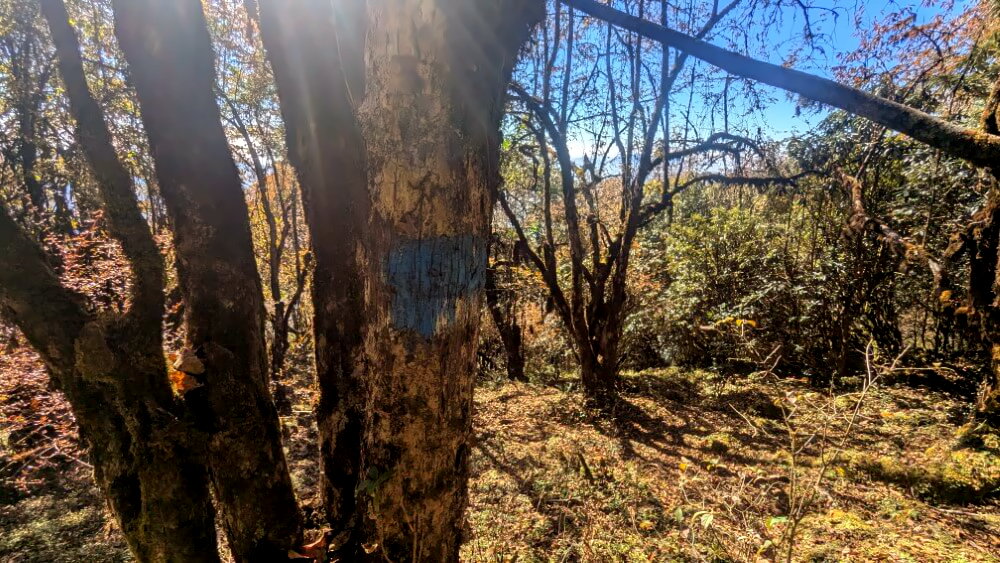
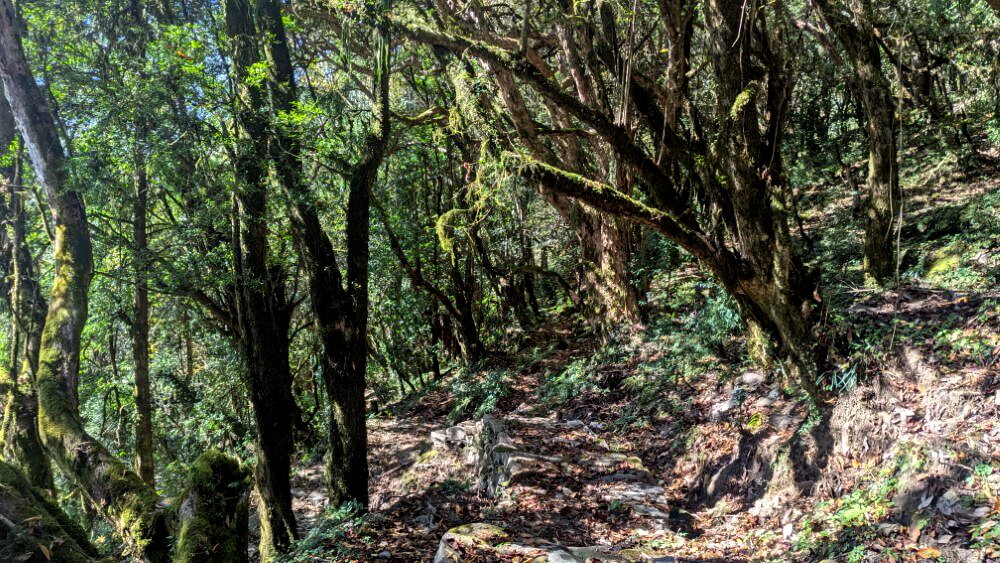
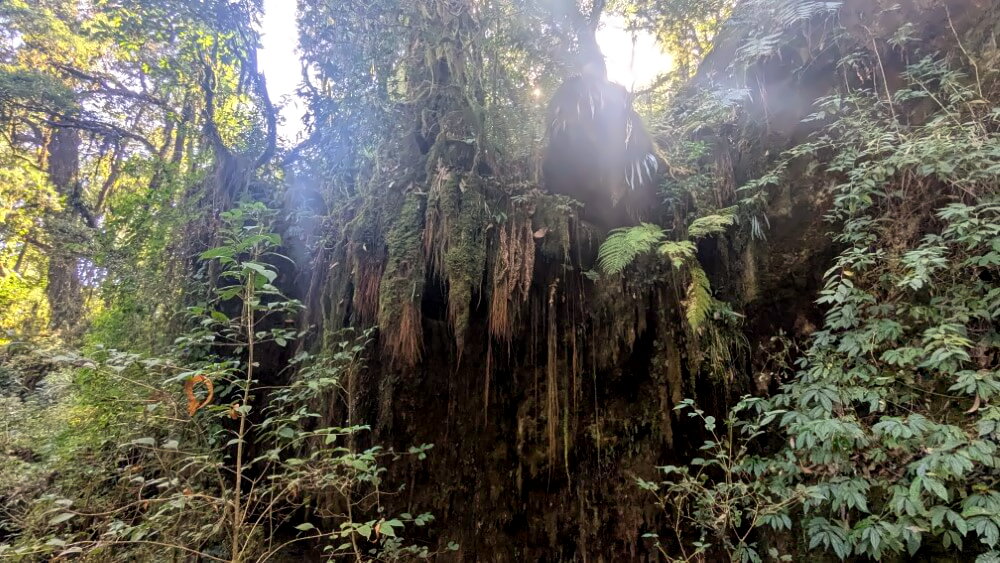
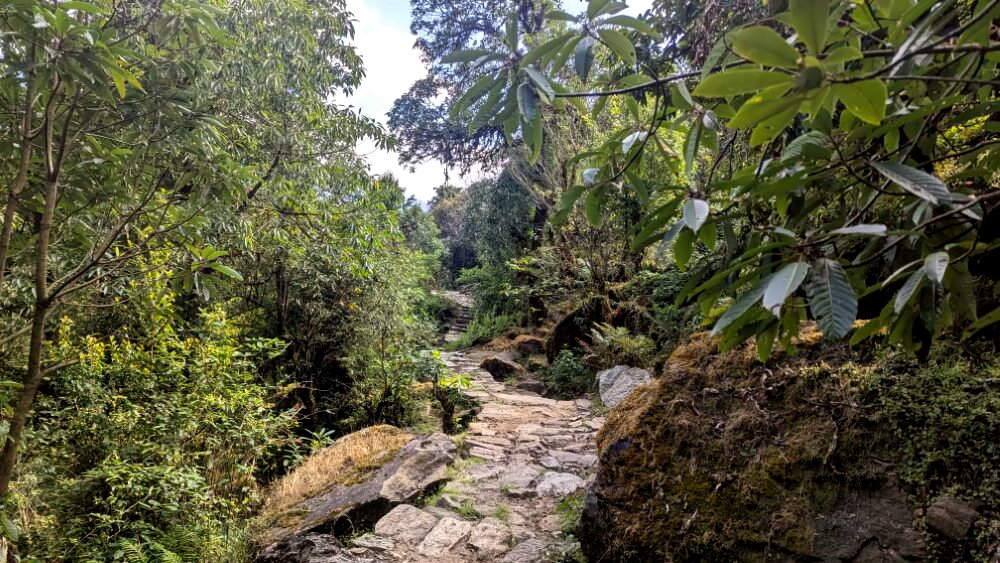
I descend a kilometer-long stone staircase through the quiet mountain forest – a beautiful stretch of the trail. Open clearings with sweeping views down to the winding Mardi Khola alternate with dense patches of woodland. I scramble between moss-covered boulders, pass hidden waterfalls and cross lively little streams. This is proper trekking!


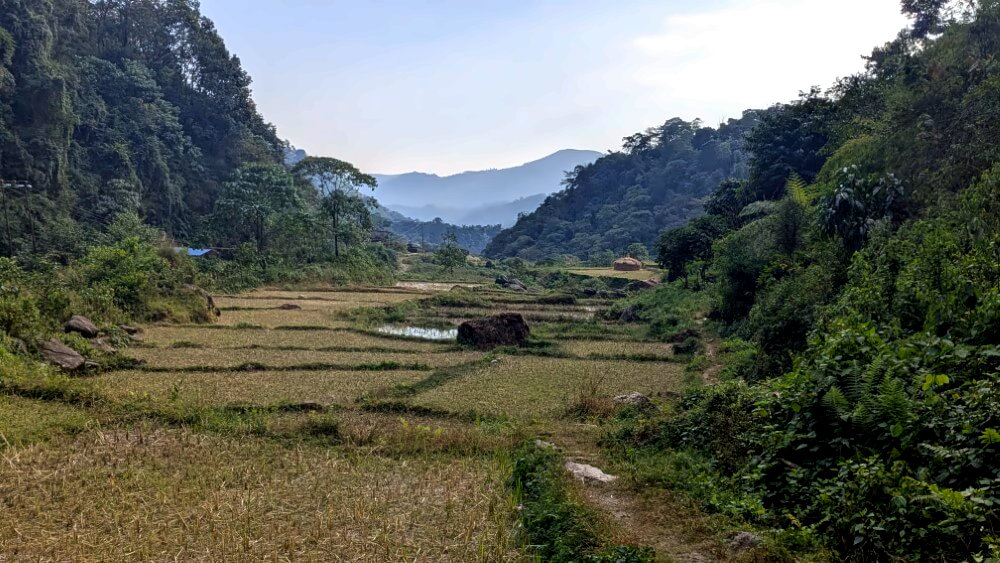
Naturally, I don’t meet a single other person. The two settlements marked on the map – Bhurung and Talung Danda – turn out to be little more than a handful of wooden huts with small vegetable gardens.
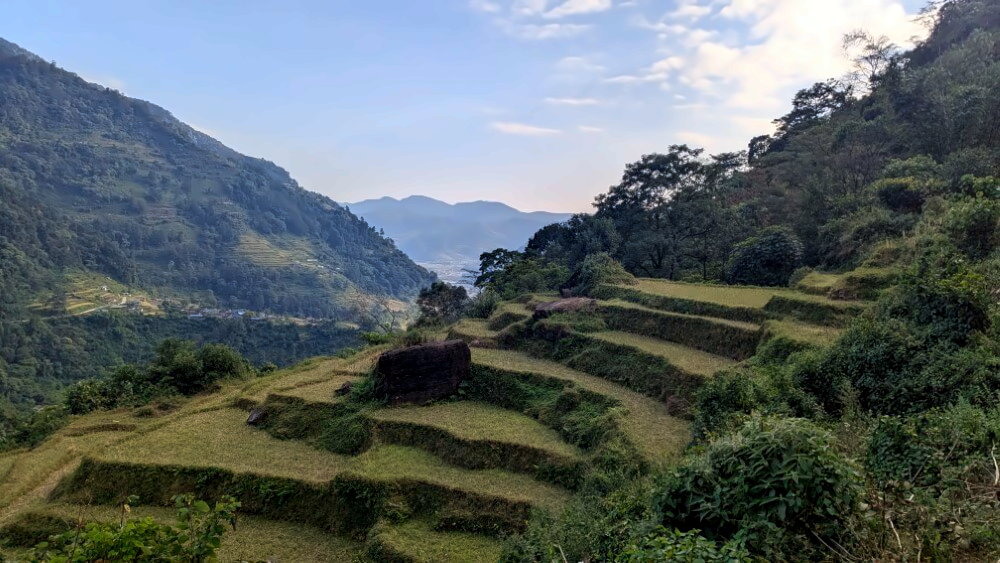
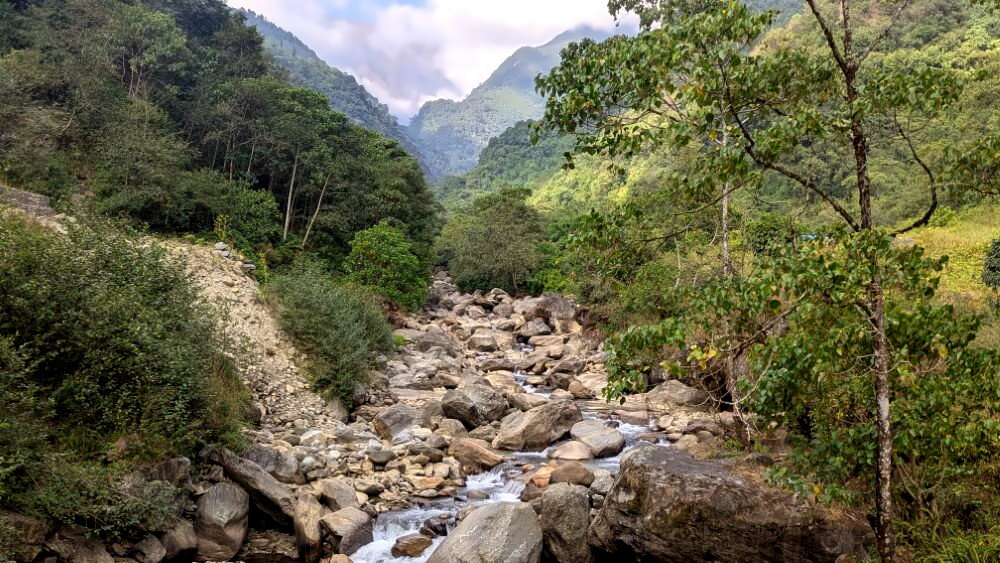
Eventually, the forest opens up, and the terraced hillsides around Sidhing come into view: a sprawling settlement, its colorful houses scattered across the entire slope. I cross the roaring Mardi Khola on a bridge, and for the final kilometers follow a mix of farm tracks and narrow footpaths along the river.
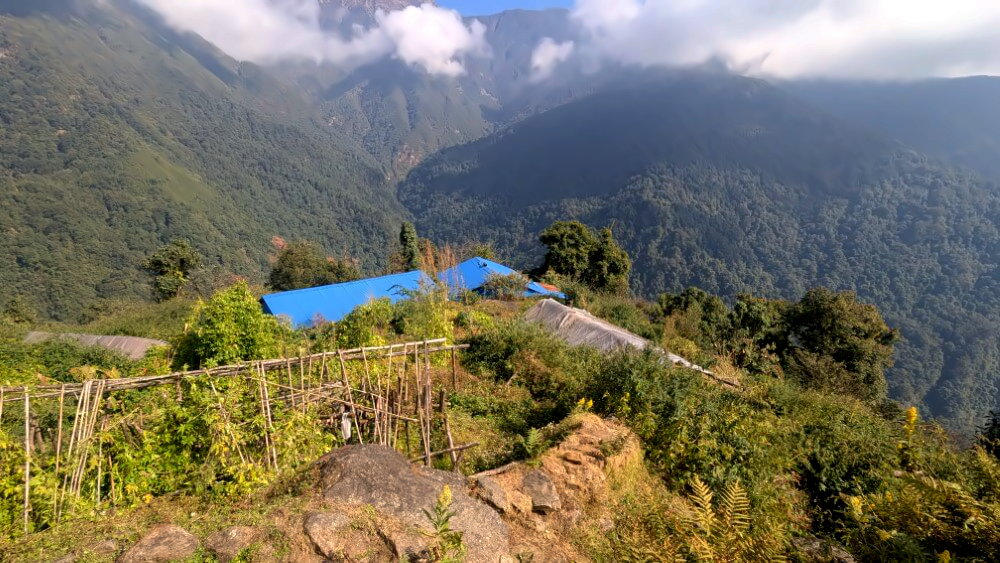
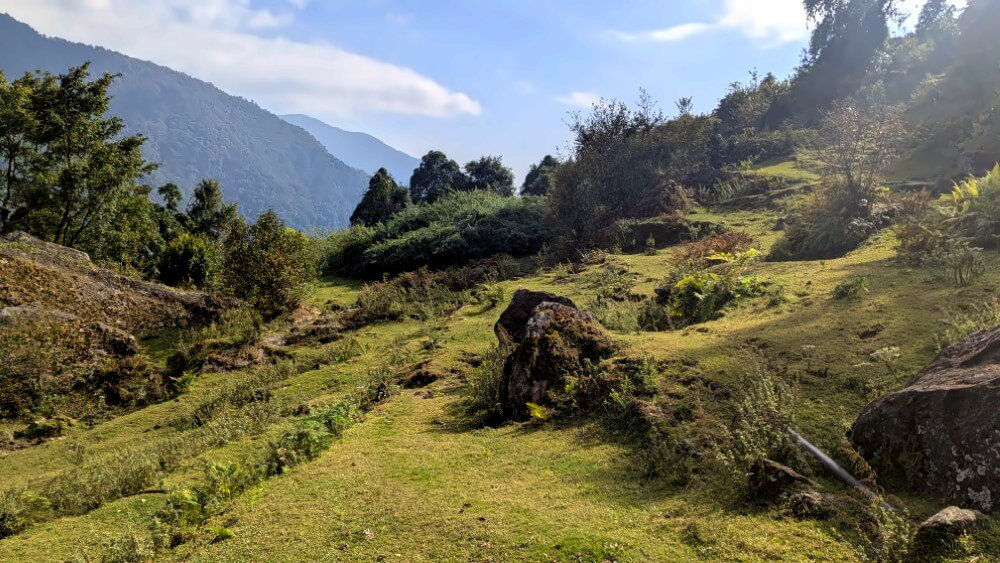
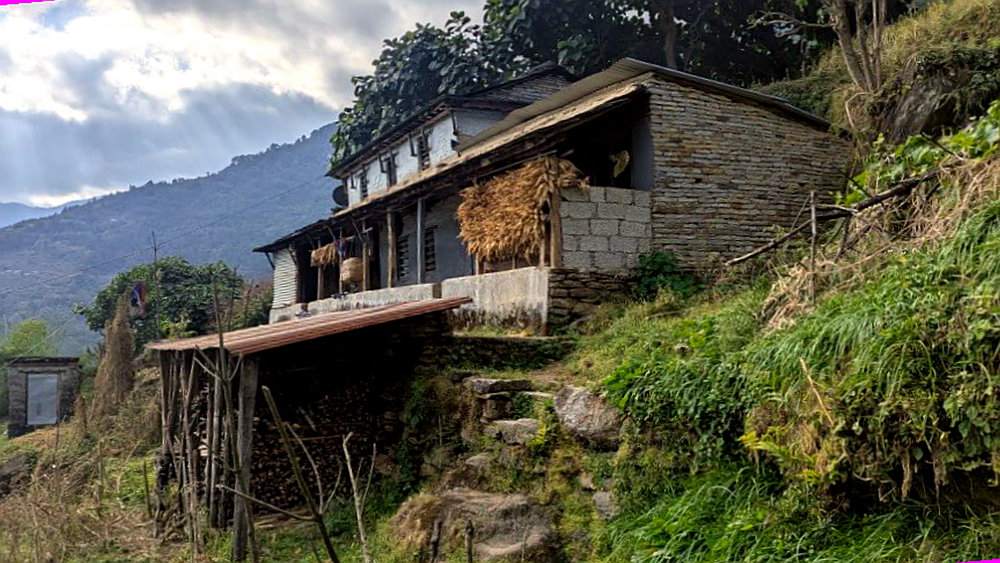
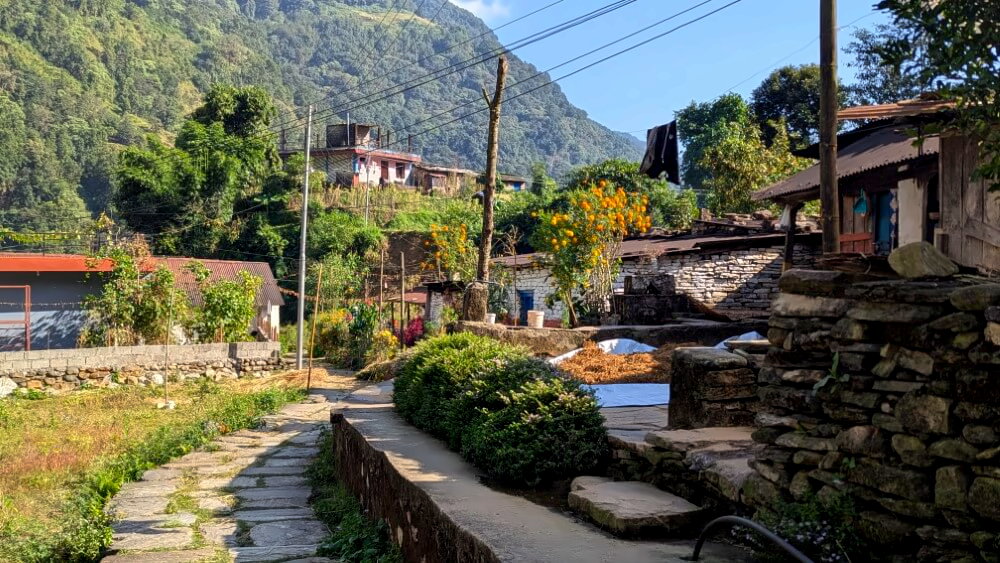
I make it to Lumre just in time, right at four o’clock – a lovely village of neat stone houses, where goats wander along the paved lanes and flowers compete in bursts of color.
In the garden of one house, a group of girls in traditional dress is rehearsing a dance, accompanied by the soft, dreamy sound of flutes. Oh… how I would have loved to stay a little longer, soaking in the atmosphere of rural Nepal.
But, as always, it`s over too soon. A sharp honk cuts through the air. I grab a quick cola from a small roadside kiosk and hop onto the bus back to Pokhara.
Outside the window, golden fields, green meadows, and scattered farmhouses drift by, while the usual Nepali pop blares from the speakers. As dusk settles in, I take one last look back. The valleys and hills are already fading into shadow, but high above them, Machapuchare still glows bright white in the last light of the day. Mardi Himal, by contrast, is already swallowed by the dark.
I’m glad I made the effort to go all the way up a second time – and I know I will be back. In a few weeks, Im going to explore the ridge on the opposite side of the valley. Im not done with the mountains of Kaski yet.
Now let’s get to the practical tips for the Mardi Himal Trek!
Getting There
The Mardi Himal Trek is easy and quick to reach—which is one of the reasons why the route is so popular. To get to the starting point in Kande, you have two options:
- Local bus / microbus: approx. 200 NPR
- Taxi / jeep: approx. 2,000 NPR
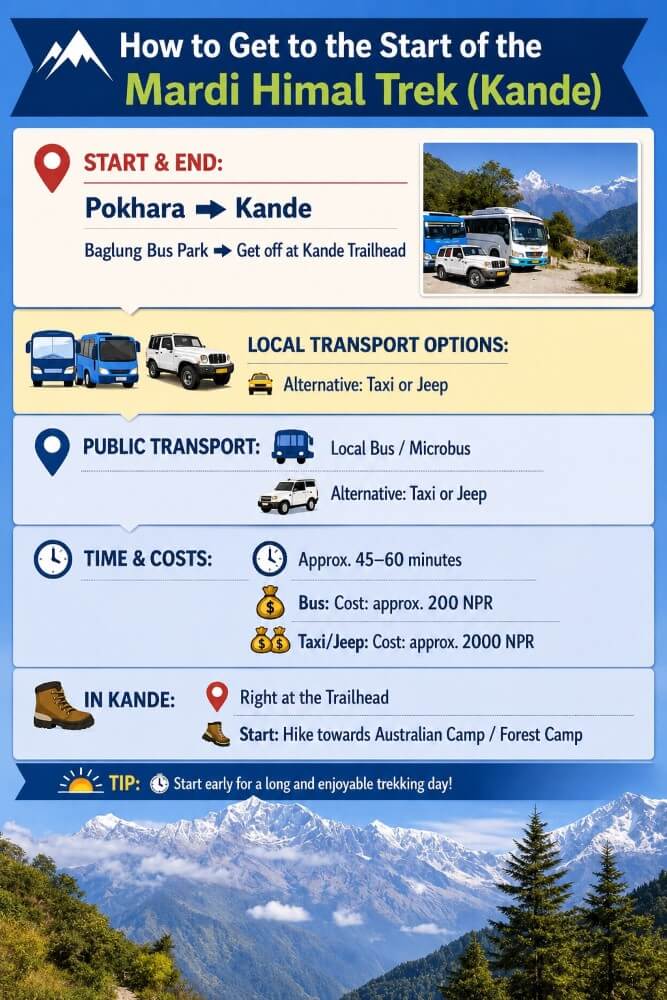
Public Bus Pokhara → Kande
1️⃣ Starting point in Pokhara
- Bus station: Baglung Bus Park
- Alternative: board along the Siddhartha Highway / Baglung Highway
2️⃣ Finding the correct bus
Take a local bus or microbus heading toward:
- Beni
- Nayapul
- Baglung
- Kushma
👉 When boarding, tell the driver: “Kande.”
3️⃣ Journey
- 🕒 Travel time: approx. 50–60 minutes
💰 Price: approx. 200 NPR - 🛣️ The route follows the road Pokhara → Naudanda → Kande
4️⃣ Getting off
- Get off directly in Kande along the main road. From there:
- 🥾 Walk uphill toward Australian Camp / Forest Camp
- The trek starts right from the roadside.
Check out my detailed city guide to Pokhara:

Taxi Pokhara → Kande
1️⃣ Starting point in Pokhara
- Anywhere in Pokhara, for example Lakeside
- You can also use the InDrive app to order a taxi.
- Every taxi driver will know Kande.
2️⃣ Journey
- 🕒 Travel time: approx. 40 minutes
💰 Price: approx. 2,000 NPR - 🛣️ The taxi follows the same road as the bus.
I personally took a taxi because I didn’t want to go to the bus station first—and taxis in Nepal are very affordable anyway (travel time about 40 minutes). If you want to cover some distance on the same day (for example hiking as far as Forest Camp), an early start is definitely recommended, which makes taking a taxi a good option.
Alternative Starting Points
Kande is the most popular starting point, but it’s not the only option. You can also begin the trek from the following locations:
- Kalimati (Mardi Khola Valley)
- Landruk (Modi Khola Valley)
- Ghatte Khola (Baglung Highway)
1️⃣ Kalimati lies not far from Sidhing. Getting there is a bit more complicated, and the road—unlike the paved Baglung Highway—is in poor condition (an off-road track). The trail from here also runs mostly through forest, so the views are limited.
2️⃣ Landruk is a good option if you’re coming directly from the Annapurna Circuit or Poon Hill. I used this route on my first visit. Here as well, most of the trail leads through forest, and the views remain limited until you reach the ridge.
3️⃣ Ghatte Khola is located a few kilometers before Kande along the Baglung Highway. The trail leads from the road via Dhampus and then up to Australian Camp. It’s also very scenic, but quite steep and involves roughly 700 additional meters of ascent.
Return Journey
With the route described in this guide, you’ll finish the trek in Lumre, where there is a bus connection back to Pokhara.
Bus Lumre → Pokhara
- Buses depart roughly every two hours.
- The last bus leaves at 4:00 p.m.
- Start early and plan about 7–8 hours for the final stage of the trek.
Alternatively, you can descend only as far as Sidhing, which is what most guided groups do. However, there are currently no buses from Sidhing—only jeeps. During the day it’s usually easy to find one, though it will be more expensive.
Jeep Sidhing → Pokhara
- 💰 Cost: about 2,000 NPR for a shared jeep (shared with other passengers) or 10,000 NPR for a private jeep
- 🕒 Travel time: about 1 hour. The first section of the road is quite rough (off-road track).
- Tip: It’s often better to leave from Kalimati instead (about 30 minutes of additional walking, but cheaper).
Still not done hiking? Around Pokhara, you’ll find plenty of other rewarding trails far away from the usual tourist routes:

Gear List for the Mardi Himal Trek
The Mardi Himal Trek is a classic lodge trek, also known as a teahouse trek, which means you’ll stay in local lodges every night. Since the maximum sleeping altitude is only around 3,500 meters, temperatures usually don’t get extremely cold at night either. As a result, you can pack very light for this trek.
Clothing
- 1 zip-off trekking pants: Maier Sports Latit Zip Pants
- 1 trekking shirt: Frilufts Cabrera
- 1 fleece pullover: Mountain Equipment Micro Zip Jacket
- 1 pair of merino underwear: Icebreaker Cool-Lite Merino
- 1 pair of long merino base layer (for sleeping): Ortovox 185 Rock ’N’ Wool Pants
- 1 merino long sleeve (for sleeping): Icebreaker 200 Oasis Long Sleeve
- 1 pair of hiking socks: Smartwool Hike Light Cushion Crew
- 1 buff / neck gaiter: Buff Merino
- 1 sun hat: The North Face Horizon Hat
- Down jacket: Montbell Plasma 1000 Alpine Down Parka
- Rain jacket: Montbell Stormcruiser
- 1 pair of thick wool socks for the evening
Gear
- GPS device for recording tracks: Garmin eTrex 32x
- Action camera + 2 spare batteries: GoPro Hero 10
- Headlamp: Petzl Actic Core
- Trekking poles: Helinox Ridgeline LB120 SA
- Dry bag: Sea to Summit Ultra-SIL Dry Bag 20 L
- Power bank: Anker PowerCore 10,000 mAh
- Smartphone: Google Pixel 7
- Charging cable for smartphone
- eBook reader
Hygiene and Medication
- 4 bandages
- 4 ibuprofen tablets
- Washcloth
- Toothbrush
- Comb
- Microfiber towel
- Contact lens solution + case
- Travel-size toothpaste
Food and Water
- Water filter: Sawyer Squeeze
- Collapsible water bottle: Platypus Platy Bottle 2 L
Tip: Bring a water filter if possible. That way, you won’t have to buy plastic bottles along the trek. I’d highly recommend this, as a lot of the waste in the region unfortunately ends up dumped somewhere in nature instead of being properly disposed of — and in some places, it’s become quite noticeable.

What I did was buy a single plastic bottle in Pokhara and simply refill it throughout the trek. For filtering, I used a Sawyer water filter together with a lightweight collapsible bottle. I collected water from taps or streams in the soft bottle and then filtered it into my drinking bottle. The setup worked extremely well and kept both weight and plastic waste to a minimum. I personally use this handy collapsible bottle from Platypus:
Gearwise, I packed everything into a small 30-liter backpack — a fake Osprey I picked up in Pokhara for around 10 dollars before the trek. I never weighed it, but I doubt it was much heavier than 5 kilograms in total.
My packing list is definitely on the minimalist side, but honestly, you don’t need much for the Mardi Himal Trek. The trails are easy to follow, food is available everywhere along the route, and you sleep in lodges every night. Compared to many other Himalayan treks, this is a very comfortable hike. Personally, I’d try to keep my backpack below 10 kilograms at most — although even that already feels a bit heavy to me. If you’ve ever wanted to try ultralight trekking in the Himalayas, the Mardi Himal Trek is probably one of the best routes to do it.
Do You Need a Sleeping Bag?
I didn’t bring a sleeping bag on my last trek in mid-November and never really missed it. Sure, evenings at around 3,500 meters can get chilly, but temperatures usually stay manageable. Most lodges provide warm fleece blankets, and if it gets colder, you can often ask for an extra one. In spring, nights are even milder, so bringing a sleeping bag becomes even less necessary.
What Hiking Shoes?
For this trek, I used a lightweight pair of Columbia trail runners that I had bought earlier in Ladakh. They turned out to be pretty much perfect for the route: light and comfortable on the endless stair sections, while still offering enough grip for the rougher natural trails above High Camp.
Personally, I think heavy hiking boots are overkill for the Mardi Himal Trek. The trails are relatively straightforward, and bulky boots would just feel unnecessarily heavy on a route like this.
Accommodation on the Mardi Himal Trek
The Mardi Himal Trek is a classic teahouse trek. At regular intervals along the route, you’ll come across clusters of lodges offering accommodation. These settlements aren’t real villages but were built specifically for trekking tourism. From mid-December onward, most lodges close for the winter. The owners return to their villages in the valleys and usually reopen in early March.
This means that during the main trekking seasons (spring and autumn) you can always stay in a lodge. Meals are also available there. Besides the typical dal bhat, most places offer Western food as well—pizza, spaghetti, pancakes, chocolate pudding, and similar dishes. You’ll also find snacks, drinks, and other small items everywhere along the route.

Compared to other teahouse routes in Nepal, there are slightly fewer lodges along the Mardi Himal Trek. One reason is that in many places there simply isn’t enough space to build them. In addition, water is scarce along the ridge, which limits development. On top of that, thanks in part to TikTok, the trek has recently become extremely popular among Nepali tourists. During peak season it can therefore happen that accommodation becomes scarce and you may have to share a room.
📍 My tip if you’re trekking independently:
Message the lodge in advance via WhatsApp. Almost all lodges are listed on Google Maps, where you can usually find their phone numbers. The owners typically reply within a few hours. In the GPS track I’ve marked several recommended lodges. Not finding a place to stay is extremely unlikely—in the worst case, they’ll simply roll out a few mattresses in the common room.
Cost breakdown of the Mardi Himal Trek
As mentioned in the introduction, the Mardi Himal Trek falls into the mid-range price category. It’s roughly as expensive as the Annapurna Circuit, a bit more expensive than Langtang, but still cheaper than trekking in the Everest region.
You should budget around 4,000–5,000 NPR per day, which should comfortably cover your expenses along the trek.
Menu with prices from Hotel Magic Mountain at Mardi Himal High Camp:





Cost Breakdown of the Mardi Himal Trek
On my second trip on the Mardi Himal Trek, I wanted to know exactly how expensive the trek really is. So I carefully noted down every rupee I spent. Below is the complete breakdown of my expenses for each day:
Day 1
- Taxi Pokhara → Kande: 2,000 NPR
- Breakfast at Australian Camp, Tibetan bread + 2 milk coffees: 700 NPR
- Double Forest Guest House, 1 black tea: 100 NPR
- Hotel Viewpoint, 1 milk tea: 150 NPR
- Teahouse Happy with Nature, 1 black tea + 1 samosa: 200 NPR
Hotel Demand
- Room: 500 NPR
- Shower: 250 NPR
- 2 black coffees + 1 Tibetan bread: 590 NPR
- Veggie spaghetti: 475 NPR
- 2 black teas: 170 NPR
Total: 5,135 NPR
Day 2
- Breakfast, chocolate pancake + black coffee: 480 NPR
- Forest Camp, black tea: 90 NPR
- Rest Camp, Tibetan bread with cheese + 1 milk coffee: 600 NPR
Hotel Low Camp
- Room: 1,000 NPR
- Shower: 300 NPR
- Pack of cigarettes: 700 NPR
- Milk coffee: 210 NPR
- Milk tea: 140 NPR
- Black tea: 100 NPR
- Pack of Pringles: 350 NPR
- Snickers: 350 NPR
- Tomato cheese pizza: 700 NPR
Total: 5,020 NPR
Day 3
- Breakfast, chocolate pancake + milk coffee: 550 NPR
- Mid Camp, black tea: 100 NPR
High Camp, Hotel Magic Mountain
- Shared room: 500 NPR
- Bucket of hot water for shower: 400 NPR
- Milk coffee: 230 NPR
- Potato cheese momo: 620 NPR
- Black tea ×3: 330 NPR
- Veggie cheese spaghetti: 570 NPR
Total: 3,300 NPR
Day 4
- Breakfast, light breakfast set: 750 NPR
- Upper Viewpoint, black tea: 200 NPR
High Camp, Hotel Magic Mountain
- Shared room: 500 NPR
- Milk tea: 300 NPR
- Pot of black tea ×2: 1,000 NPR
- Potato cheese momo: 620 NPR
- Chocolate pudding: 520 NPR
Total: 3,890 NPR
Day 5
- Breakfast, chocolate pancake + 2 milk coffees: 910 NPR
- Lunch package (chapati, hard-boiled egg, Snickers): 600 NPR
- Bus Lumre → Pokhara: 300 NPR
- Taxi from Pokhara city center to Lakeside: 500 NPR
Total: 2,310 NPR
- + 3,000 NPR for the ACAP permit
💰 Total cost of the Mardi Himal Trek (5 days): 22,655 NPR (~150 $)
As you can see from the breakdown above, about 90% of the money goes toward food. Even so, for Westerners it’s still a very inexpensive trek—and I wasn’t even being particularly frugal. In the popular hiking regions of the Alps, you could easily pay that much for a single overnight stay with meals in a hut.
📍 Important: Make sure to bring enough cash from Pokhara or Kathmandu. There are no ATMs along the trek, and you cannot pay by credit card in the lodges.
Mardi Himal Trek: Go Independent or Hire a Guide?
The Mardi Himal Trek is beginner-friendly and not particularly difficult. A guide is not required, and you’ll come across plenty of solo trekkers along the way. Whether you go with or without a guide ultimately comes down to personal preference—both options work well. Personally, I prefer going without one for the added flexibility.
If you’re trekking independently:
- 🗺️ Download an offline map: Make sure you have a map of the region on your phone—ideally with a GPS track.
- 🧭 Ask locals if you’re unsure: When in doubt, check with locals about trail conditions or directions.
- 🚫 Stay on the trail: The terrain offtrail can be steep and unforgiving. Don’t take shortcuts.
- 🌧️ Be prepared for weather changes: Always carry proper rain gear.
- 🌙 Avoid hiking in the dark or in rain: The risk of slipping increases significantly.
- ⏳ Ascend slowly: Stick to a maximum of 500 meters of elevation gain per day.
- ⚠️ Take altitude sickness seriously: No exceptions.
- 🥾 Descend if symptoms occur: It’s the only reliable solution.
Permits Required
For the Mardi Himal Trek, you only need one permit: the Annapurna Conservation Area Permit (ACAP). It costs 3,000 NPR and can be obtained in the following ways:
- Tourist Office in Pokhara
- Tourist Office in Kathmandu
- Online via the ePermit system (my recommendation)
📍 If you apply online, it’s enough to show the PDF or a screenshot on your phone.
The permit is checked at the ACAP checkpoint just past Pothana – the only checkpoint along the route. A TIMS card is not required and is irrelevant for independent trekkers. I’m mentioning it here because I still get asked about it regularly. Short answer: you don’t need it. A guide is also not mandatory—solo trekking is allowed.
📍 Further reading: Solo trekking in Nepal – current regulations
How Difficult is the Mardi Himal Trek?
The trails up to Mardi Himal High Camp are technically straightforward: wide, well-maintained paths that are often stone-paved. What really gets you, though, are the sustained climbs, especially the sections on stairs. That’s one more reason to keep your pack as light as possible!
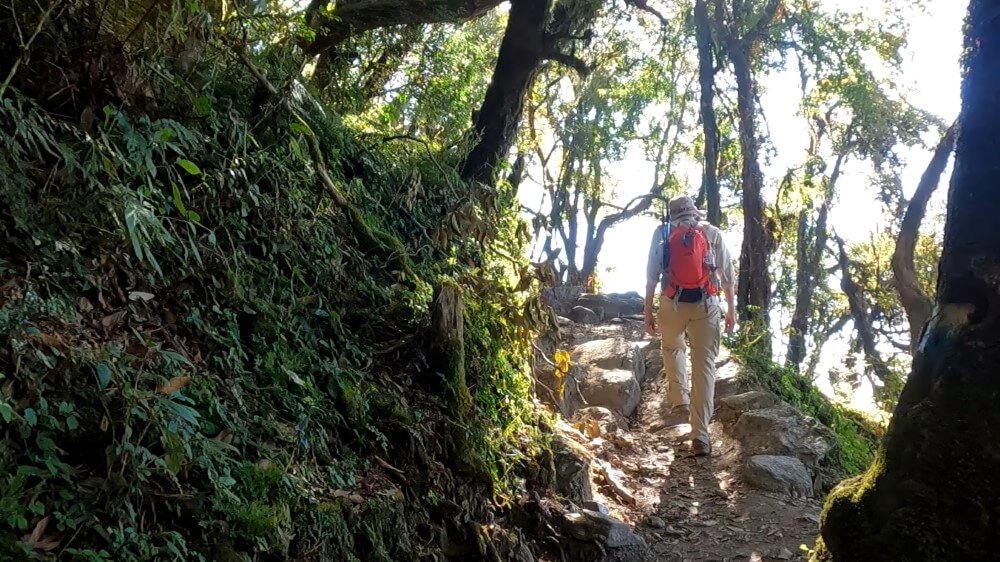
From High Camp to Mardi Himal Base Camp, the trail turns into a regular mountain trail – nothing unusual if you’ve hiked in places like the Alps. Just past the Lower Viewpoint, there’s a short section (around 5 meters) where the trail becomes a bit narrower and slightly exposed. Aside from that, the ridge stays comfortably wide with no technical sections or scrambling involved.
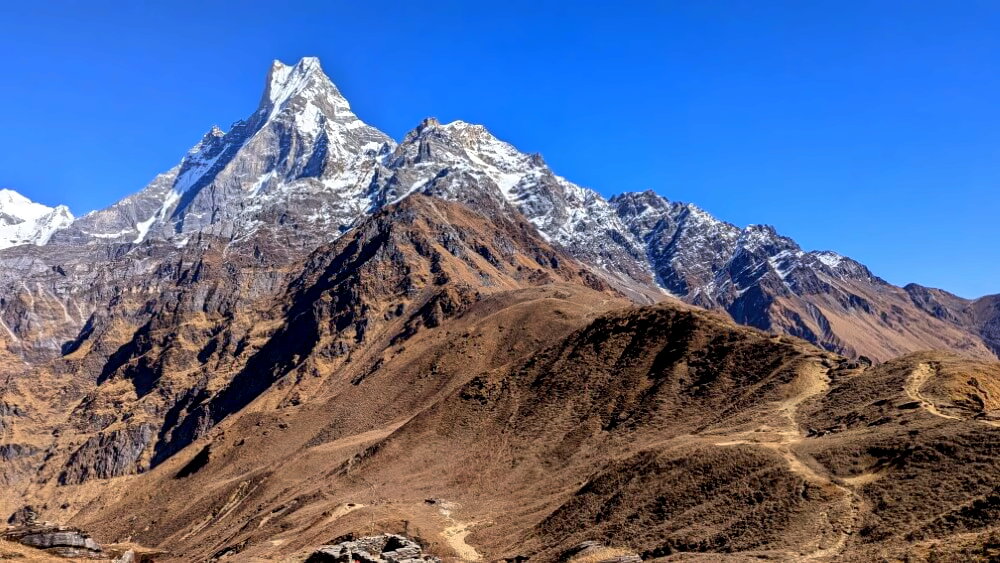
The direct descent from High Camp to Sidhing starts off across fairly steep grassy slopes for a few hundred vertical meters (around a 35° incline). That said, the trail is always easy to follow and wide enough to walk safely. There are no exposed sections and in good weather, the route is generally not dangerous.
Best Time to Visit the Mardi Himal Trek
As mentioned earlier, I’ve done the Mardi Himal Trek twice: once in late April and once in mid-November, right before heading to the Manaslu Circuit. The second time was clearly better. Autumn (mid-October to early December) is the ideal season for this trek.
❓ Why?
- 🌤️ Crystal-clear air after the monsoon → the best views of Annapurna, Machapuchare & beyond
- 🏔️ Stable weather with far fewer clouds building up in the afternoon
- 🥾 Dry, easy-to-walk trails, especially on the unpaved ridge sections
- 🌡️ Comfortable temperatures for long ascents (warm during the day, cool but not freezing at night)
- 📸 Maximum panoramas – which is exactly what this trek is all about
For comparison, here are a few pictures of Mardi Himal Trek in April (left) and November (right):


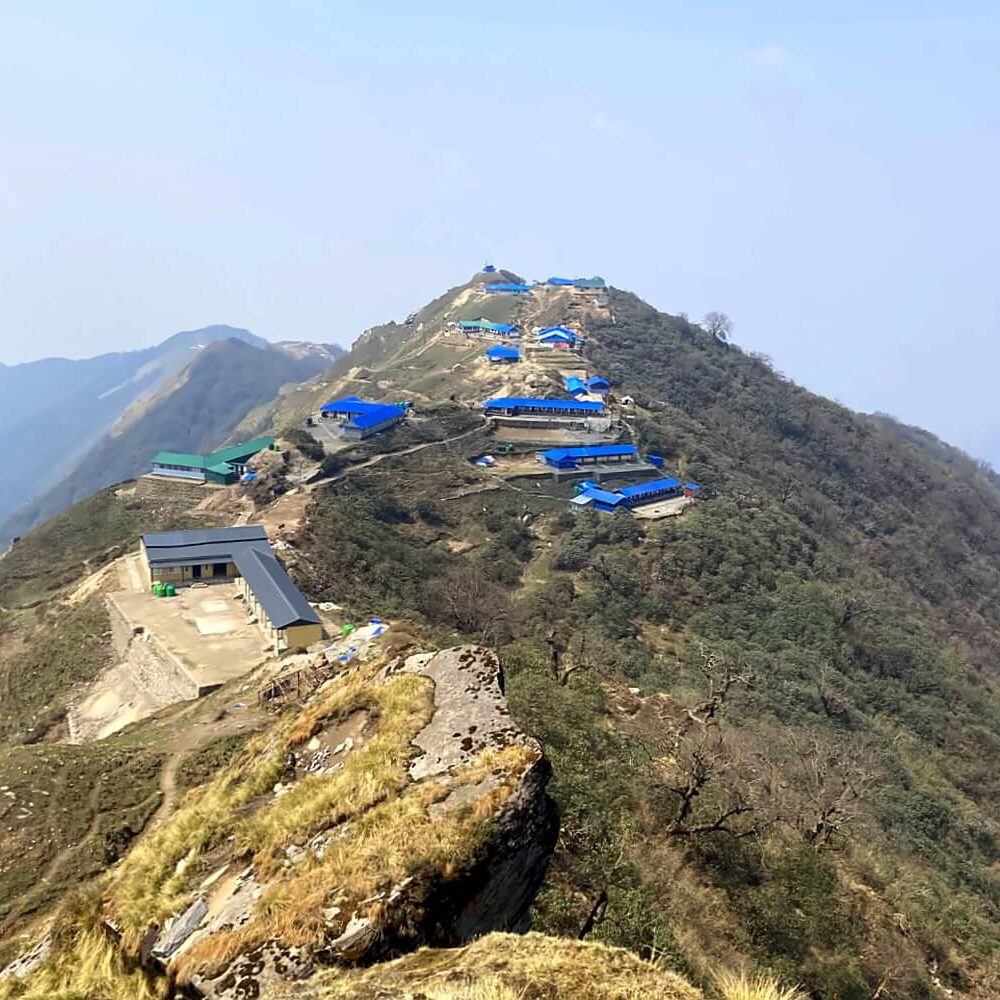
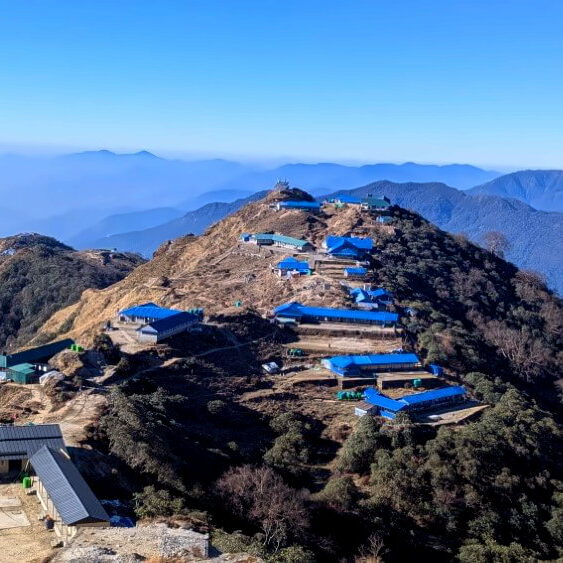
During my first trek in late April, visibility was pretty poor. The southern Annapurna region is heavily affected by warm, humid air from India which tends to build up quickly. After around 9 a.m. the mountains were often completely lost in the haze. I had clear views only for a few hours right after sunrise. So, autumn is definitely the better choice – even though the blooming rhododendron forests in spring are undeniably beautiful.
If you do the trek in spring, I’d definitely recommend starting early – especially from High Camp (no later than 5:00 a.m.). That way, you’ll at least catch a few hours of clear views. From around 8:00 a.m. onwards anything more than a few kilometers away tends to disappear in white haze. Since this trek is all about distant views of the high Himalayas that can be pretty frustrating.
How to Combine the Mardi Himal Trek with Poon Hill or ABC
Thanks to the dense network of trails in Kaski region, most villages are connected by footpaths and dirt roads. That makes it easy to combine the Mardi Himal Trek with other routes—most notably the Poon Hill Trek or the Annapurna Base Camp (ABC) Trek.
From Mardi Himal, the village of Landruk is the ideal starting point for these extensions. From Landruk, you have a couple of great options:
Mardi Himal + Poon Hill Trek (+4 days)
- Landruk → Ghandruk: ~4 km, +720 m / -350 m
- Ghandruk → Tadapani: ~6 km, +650 m / -5 m
- Tadapani → Ghorepani: ~8.5 km, +1,100 m / -935 m
- Ghorepani → Ulleri → Nayapul: ~18 km, +110 m / -1,960 m
Mardi Himal + Annapurna Base Camp (+5–6 days)
- Chomrong → Ghandruk: ~9.5 km, +1,350 m / -1,320 m
- Landruk → New Bridge → Jhinu Danda → Chomrong: ~9.5 km, +1,850 m / -1,471 m
- Chomrong → Deurali: ~13 km, +1,500 m / -440 m
- Deurali → Annapurna Base Camp: ~7 km, +1,300 m / -130 m
- Annapurna Base Camp → Chomrong: ~20 km, +500 m / -2,900 m
In total, you’ll need around 10 days if you want to combine either of these options with the Mardi Himal Trek. Alternatively, you can simply hike from village to village without sticking to a fixed itinerary. There are lodges with food in almost every settlement – that’s exactly what makes trekking in Kaski so easy.

Final thoughts
After my somewhat underwhelming first experience, I honestly didn’t expect to come back saying this – but the Mardi Himal Trek really is a fantastic hike. Returning in autumn made all the difference and it’s the kind of trek that simply felt good from start to finish: not overly difficult, yet incredibly rewarding.
Yes, Mardi Himal is popular these days and no longer a secret. But even in mid-November, the trail never felt excessively crowded to me. And if you take a little extra time, maybe even venture onto one of the quieter side routes, it’s still easy to find moments of real solitude in the mountains.
So if you only have a few days around Pokhara and want a relaxed trek with maximum scenery, the Mardi Himal Trek is hard to beat. I certainly didn’t regret giving it a second chance.
Did you enjoy reading this article? Then consider treating me to a virtual coffee.

Without coffee I can’t get out of the bed in the morning to experience new adventures 🙂
Disclaimer: This article contains affiliate links marked with an asterisk * that lead to online retailers such as Amazon. If you click on such a link and buy something, I will receive a small share that helps finance this blog. This is the best way for you to say thank you if you liked the post. Of course, there are no additional costs for you.
Do you have any questions about the Mardi Himal Trek? Anything missing in the article? Do you know other exciting treks in Nepal? Let me know in the comments – I look forward to hearing from you!